
NEWS
ASUS Prices the OLED ROG Xbox Ally X20 at $1,299
ASUS now sells the OLED ROG Xbox Ally X20 standalone at $1,299 after a year of saying that panel and VRR could not share a handheld.

ASUS is taking $1,299 pre-orders for the ROG Xbox Ally X20, the first OLED Xbox Ally, with units due on October 15. The handheld keeps the AMD Ryzen AI Z2 Extreme, 24GB of RAM, and 1TB SSD from last year’s Ally X. The screen, the cooling, and a $299 jump are what changed.
In June 2025, ASUS said OLED with variable refresh rate drew too much power and cost too much for a second screen in someone’s bag. The X20 is that refusal, priced and on a calendar.
Last Year ASUS Refused OLED to Keep VRR
Whitson Gordon, then ASUS senior manager of content marketing for gaming, was blunt after the Xbox Ally reveal. The company had prototyped OLED. It would not ship it if that meant dropping VRR, which Gordon treated as the floor for a 2025 gaming screen.
We did look at OLED again this year, we did some R&D and prototyping with OLED, but it’s still not where we want it to be when we factor VRR into the mix. And we aren’t willing to give up VRR, I’ll draw that line in the sand right now.
Whitson Gordon, Senior Manager of Content Marketing, ASUS
He added that OLED with VRR “draws significantly more power than the LCD that we’re currently using on the Ally, and it costs more.” A longer riff from the same session went further on price: stacking extra RAM, OLED, and the Z2 Extreme “would cost a lot more than the price bracket you guys are used to on the Ally,” and most buyers, he said, would not pay it.
The Ally X landed at $999.99 with a 7-inch IPS panel, 500 nits, 120Hz, and FreeSync Premium. Battery life, raw speed, and the Xbox-mode software stack got the engineering time. The panel did not.
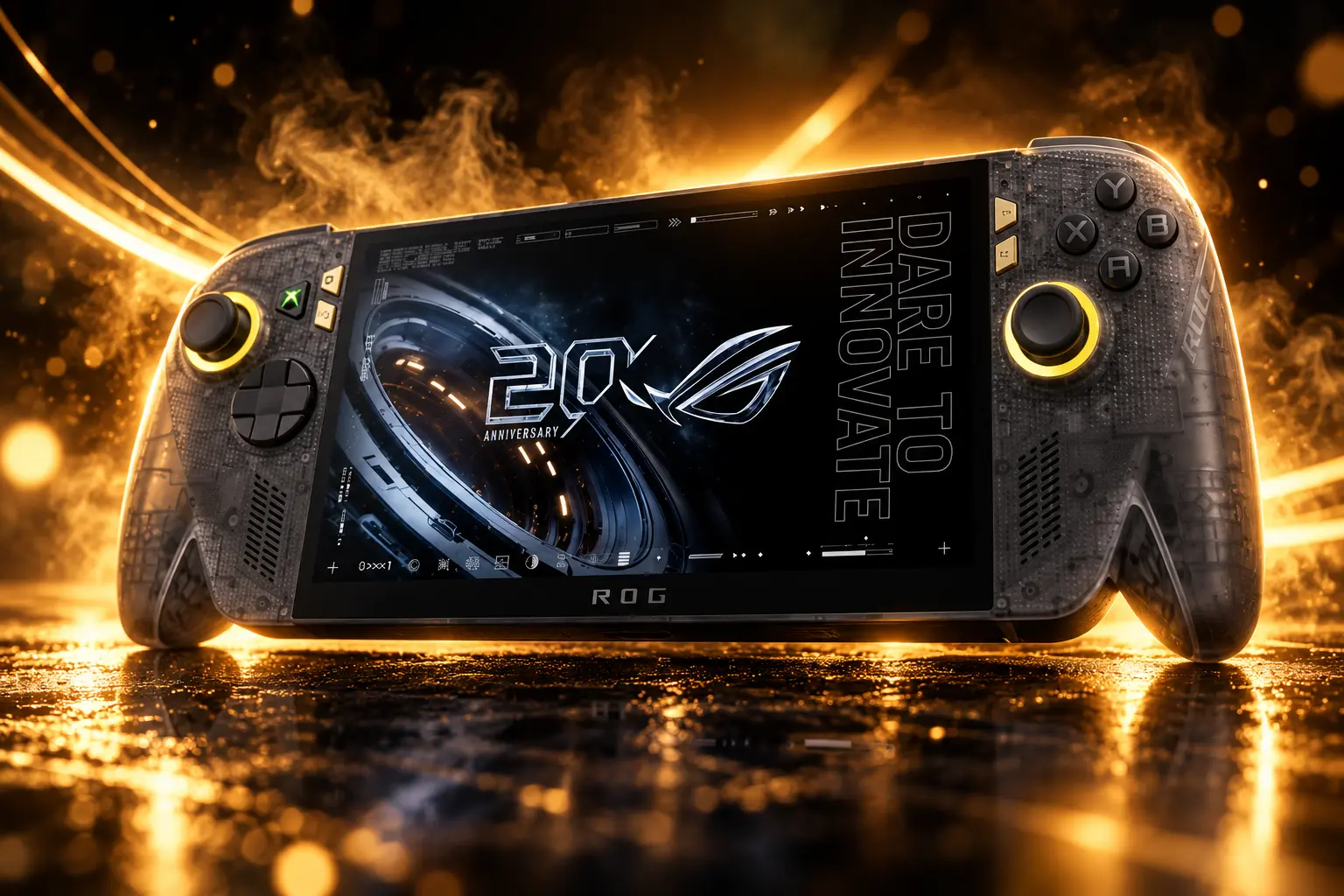
On June 1, 2026, at Computex, ROG put a translucent black-and-gold X20 on stage as a 20th anniversary machine, founded in 2006, with a 7.4-inch OLED that keeps VRR. There was no price.
https://x.com/ASUS_ROG/status/2065367129252319267
The replies under that clip were not about nits. People wanted a number, and a few wanted SteamOS on a Windows handheld that will not ship it. The number took 85 days.
The Same Chip Now Drives a 7.4-Inch OLED
ASUS did not refresh the silicon. Official spec sheets for the Ally X (2025) and the X20 list the same AMD Ryzen AI Z2 Extreme: 8 cores, 16 threads, up to 5.0GHz, and an NPU rated up to 50 TOPS. AMD’s own chip page puts default TDP at 28W, with a 15 to 35 watt cTDP range, 3 Zen 5 cores plus 5 Zen 5c cores, and 16 RDNA 3.5 graphics cores.
Memory and storage match: 24GB of onboard LPDDR5X and a 1TB PCIe 4.0 M.2 2280 SSD. The battery is still an 80Wh four-cell pack. Windows 11 Home is still the OS, with Xbox mode for controller-first navigation.
The screen is the new product. ASUS lists a 7.4-inch OLED and 756 g chassis on the X20, against 7 inches and 715 g on the Ally X. That is 41 g more, and the body is 1.0 cm wider (30.0 cm against 29.0 cm).
ALLY X VERSUS X20
| Spec | Ally X (2025) | Ally X20 |
|---|---|---|
| Display | 7-inch IPS, 500 nits, 120Hz | 7.4-inch OLED, 600 nits SDR / 1,400 nits HDR, 120Hz |
| VRR | FreeSync Premium | FreeSync Premium Pro, 30Hz to 120Hz |
| Chip, RAM, SSD, battery | Z2 Extreme, 24GB, 1TB, 80Wh | Same |
| Weight / adapter | 715 g / 65W | 756 g / 68W |
| US price | $999.99 | $1,299 |
Color coverage moves from 100% sRGB on the IPS panel to 100% DCI-P3 on the OLED. ASUS also lists VESA True Black 1400, Dolby Vision, a 0.2ms response time, Pantone validation, and Corning Gorilla Glass Victus with DXC glass. An anti-reflective coating, the company says, cuts glare by 65%.
Those figures are why the $299 gap is not a faster chip. It is a brighter, larger OLED with a wider VRR window, plus the cooling and chassis work required to put that panel next to the same APU.
A New Air Path Cools the OLED Panel
OLED runs hotter than the IPS sheet in the Ally X, and ASUS said so in the June 1 press release. The thermal layout on the X20 was rebuilt to push more air at the APU and to keep the front of the panel cooler.
ROG describes an internal channel and higher-flow fans, visible through the translucent shell, with gold-plated fans as part of the anniversary finish. The adapter steps from 65W on the Ally X to 68W. Early hands-on sessions have held 1080p at 60 FPS on medium in Forza Horizon 6, which is in line with a chip that did not change.
The other software card is Microsoft’s Automatic Super Resolution. ASUS says X20 owners can use the Auto SR preview, the Windows upscaler already on Copilot+ PCs. Microsoft’s own support page still frames the Auto SR preview for docked play on the Ally X, with Xbox Insider enrollment and a TV or monitor in the loop. Treat it as a docked tool until that page moves.
USB4 on the X20 lists DisplayPort 2.1 with FreeSync, up from DisplayPort 1.4 on the Ally X spec sheet, and the card reader is microSD Express. Those are quiet ports changes next to the screen, and they matter once the unit is on a desk.
The $2,499 Bundle Did Not Survive Gamescom
Computex presented one SKU: the handheld plus ROG XREAL R1 Edition 20 glasses. ASUS did not say the handheld would sell alone. For two months the public argument was whether anyone would buy an OLED Xbox handheld only as a glasses kit.
The glasses are a real accessory, not vapor. They use Sony micro-OLED panels at 1920×1080 per eye, a 171-inch virtual image at 4 meters, 240Hz with frame-rate boost, 0.01ms panel response, a 57-degree field of view, and 3DoF tracking, with Bose-branded audio in the later press materials. They plug in over a single USB-C cable. ROG prices them at $799 on their own, with a mid-September 2026 sale window.
On August 25, 2026, during Gamescom, ASUS cut the knot. The company opened pre-orders at $1,299 ahead of October 15 for the handheld alone, and $2,499 for a bundle that still includes the glasses, a dbrand Killswitch with kickstand and themed skin, a 68W adapter, and a custom Pelican Protector Case. Both the X20 and the glasses, the press release says, will sell separately.
Subtract the $1,299 handheld and the $799 glasses from the $2,499 kit and $401 is left for the cases, skin, stick caps, and charger. That is a collector pack, not a discount.
FROM COMPUTEX TO THE SHELF
- June 1, 2026: ASUS unveils the X20 at Computex as a 20th anniversary bundle with ROG XREAL R1 Edition 20 glasses and no price.
- August 25, 2026: Pre-orders open for a $1,299 standalone unit and a $2,499 bundle; ASUS store and Best Buy take US orders.
- Mid-September 2026: ROG schedules standalone glasses sales.
- October 15, 2026: X20 units are due on shelves.
That sequence is why the glasses bundle ASUS first showed now reads as a Computex costume. The hardware people actually wanted, the OLED handheld, is the $1,299 SKU.
What $1,299 Buys Over the Ally X
Three hundred dollars is the street shorthand; the official gap is $299 against the $999.99 Ally X. ASUS is keeping that LCD model on sale, so the X20 is an upsell, not a replacement.
For that money you get the 7.4-inch OLED, FreeSync Premium Pro from 30Hz to 120Hz, TMR sticks, the transforming D-pad, flush face buttons, rubberized grips, a 68W brick, and the see-through black-and-gold shell with gold joystick lighting and a backlit green Xbox button. You do not get more cores, more RAM, more storage, or a bigger battery.
Owners who already live on a Steam Deck OLED are the ones stalling. They already paid for inky blacks on a handheld, and a second $1,299 Windows unit is a harder sell than it is for someone coming off the Ally X’s IPS sheet. Pre-order listings in early September were still sitting, which is not the panic buy some anniversary drops get.
The other comparison is the rest of the Windows handheld rack, where OLED and large panels have been climbing for a year. That is how handheld prices moved this year, and the X20 sits in that band rather than in the $600 Xbox Ally lane.
Two months of Xbox Game Pass Premium come in the box, with the usual market limits. Security hardware includes Microsoft Pluton and a fingerprint sensor. Product security updates are listed through December 31, 2030.
TMR Sticks Drop Deadzone to 3 Percent
If the screen is the poster, the sticks are the part that will matter six months in. ASUS moved the X20 to tunnel magnetoresistance joysticks with Aura RGB rings, and ROG’s own write-up puts the deadzone at 3%, with a new algorithm that is meant to kill four-axis snapping and keep power draw low. The pitch against Hall effect is more precision, not just drift resistance.
The D-pad is a hybrid rubber-and-metal dome that swaps between 4-way and 8-way input, the four-way for tight indie movement and the eight-way for fighting games. Face buttons now sit flush when pressed so thumbs can slide across them. Rear grips get a rubberized coating. Impulse triggers and Hall-effect analog triggers both appear on the spec list, with two assignable grip buttons, HD haptics, and a 6-axis IMU.
WHAT ACTUALLY CHANGED IN THE HANDS
- TMR joysticks: Magnetic sensors with a 3% deadzone, RGB rings, and a claim of less snap and less power use than Hall effect sticks.
- Transforming D-pad: Instant switch between 4-way and 8-way, built as a rubber-and-metal dome.
- Flush face buttons: Shorter travel so thumbs slide instead of catching the edge of the shell.
- Rubberized grips: Extra coating on the Xbox-style handles for long sessions.
Those are the pieces Gordon’s 2025 talk never had to price. They are also the pieces LCD Ally X owners cannot bolt on. Stick drift kits exist; a 7.4-inch OLED and a new air channel do not.
The X20 Reaches Shelves on October 15
US buyers can pre-order the standalone X20 for $1,299 and the anniversary bundle for $2,499 at the ASUS store and Best Buy. Units are due on October 15, 2026. The Ally X stays at $999.99 for anyone who wants the same chip without the panel.
Gordon’s line in the sand was VRR, power, and a price people would actually pay for a second device. The X20 keeps VRR, adds OLED, and asks $299 more, after a bundle-only detour that did not last the summer. The first real check is whether that number moves units in October, not whether the screen looks better than 500-nit IPS. It will.

Windows 11 26H2 Turns Settings Backup On by Default

The Gears 2 PC Port Epic Refused to Ship

Ghost Recon Wildlands Returns at 4K as a Catalog Product

Waterpark Simulator Keeps the $12.99 Price After 1.0

Nurix Puts NuPlay on Microsoft Marketplace to Reach Azure Buyers

Warzone Leaves Xbox One and PS4 After Season 06

Microsoft AI Was Set Free to Build Its Own Frontier

Microsoft IQ Turns Workplace Data Into a Metered Agent Brain

Xbox Games Showcase 2026 Split the Catalog in Two

Nadella Banned Addiction Talk While Scout Kept Heartbeat
-
 NEWS5 months ago
Warzone Leaves Xbox One and PS4 After Season 06
-
 NEWS5 months ago
Microsoft AI Was Set Free to Build Its Own Frontier
-
 MICROSOFT 3655 months ago
Microsoft IQ Turns Workplace Data Into a Metered Agent Brain
-
 NEWS5 months ago
Xbox Games Showcase 2026 Split the Catalog in Two
-
 MICROSOFT 3655 months ago
Nadella Banned Addiction Talk While Scout Kept Heartbeat
-

 NEWS5 months ago
Modern Warfare 4 Splits Its Audience Before the October Launch
-

 NEWS5 months ago
Infinity Ward Bets Modern Warfare 4 on a Paid DMZ
-

 NEWS5 months ago
Dragonwilds Hits Xbox, but Steam Saves Stay Put