
MICROSOFT 365
Microsoft’s Agentic AI Push Now Runs Through the Consultancies
KPMG and Atos adopted Agent 365 as Microsoft Copilot reached 30 million paid seats and cloud margin slipped to 65%.

Microsoft closed the year to June 30, 2026 with more than 30 million paid Microsoft 365 Copilot seats. That print landed seven weeks after KPMG and Atos put Agent 365 at the center of their own firms.
The June 9 deals read like customer wins. They also handed Microsoft a sales force that already sits inside audit rooms, tax files, and regulated IT estates, and that now bills clients to govern the agents Copilot Studio makes easy to spawn.
KPMG Put Agent 365 Over 276,000 Professionals
KPMG and Microsoft said on June 9, 2026 that member firms will roll Copilot across more than 276,000 professionals, two years after the firm first switched the assistant on. Agent 365 is the other half of the pact. KPMG will use it to manage, monitor, and update agents across the global network and to fold those controls into its Trusted AI rules.
Lisa Heneghan, global chief digital officer at KPMG International, tied the buy to client work, not a lab demo. The firm is wiring Agent 365 into KPMG Workbench, a multi-agent layer built on Microsoft Foundry, and into KPMG Clara, the smart audit platform. Microsoft has labeled KPMG a Frontier Firm, its name for shops that rebuild the operating model around agents rather than bolting a chatbot onto old workflows.
The same day, Atos Group said it would put Microsoft 365 Copilot on every one of its 56,000 employees in 54 countries, using Microsoft 365 E7 as the bundle. Agent 365 is how Atos plans to run a fleet of 19,000 AI agents through the same admin and security jobs its IT teams already run. Atos called itself the first French global systems integrator to deploy Copilot, and one of the first France-headquartered firms on E7 from the day that suite went live.
TWO FIRMS, ONE CONTROL PLANE
| Firm | People on Copilot | Agent 365 job | License stack |
|---|---|---|---|
| KPMG | More than 276,000 professionals in 138 countries | Govern agents inside Workbench, Clara, and client estates | Copilot plus Agent 365; named a Frontier Firm |
| Atos Group | 56,000 employees in 54 countries | Run 19,000 agents, including ones with their own credentials | Microsoft 365 E7 with Entra, Defender, Intune, and Purview |
Deb Cupp, Microsoft’s chief revenue officer for global enterprise, described the KPMG pact as a way to move clients from experiments to production. Frédéric Aubrière, Atos Group chief digital and information officer, went further on what the E7 buy means inside his own company.
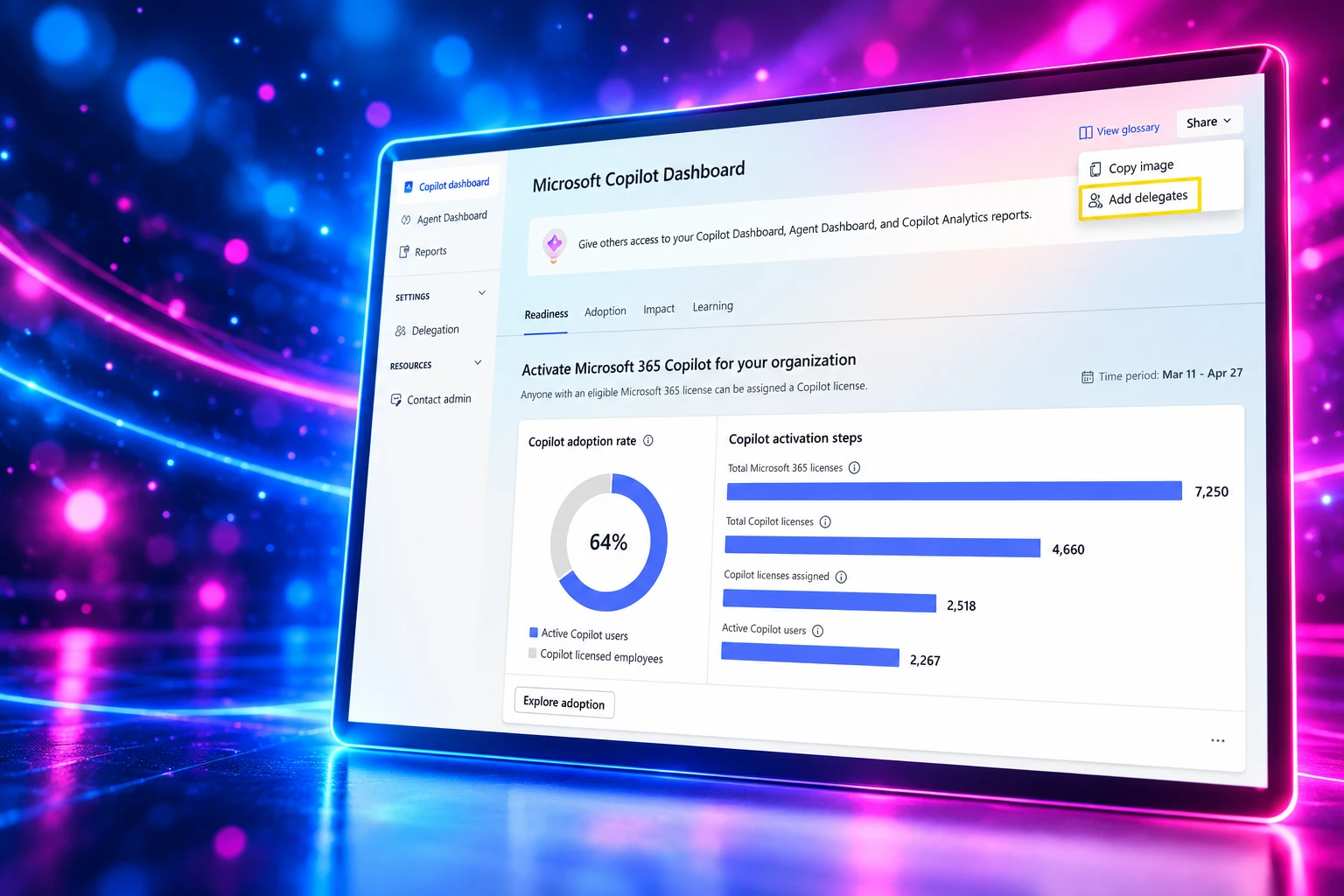
Copilot Paid Seats Hit 30 Million in One Quarter
Microsoft reported fourth-quarter results for fiscal 2026 on July 29. Revenue was $90.0 billion, up 18%, and above the $86.7 billion to $87.8 billion range the company had set on April 29. Operating income was $40.6 billion, up 18%. Azure and other cloud services grew 43%, and Nadella said Azure revenue surpassed $100 billion for the first time in a fiscal year.
Copilot paid seats were above 20 million at the end of the third quarter. They were above 30 million by June 30, a gain of at least 10 million seats, or 50%, in one quarter. Amy Hood, chief financial officer, told employees that net paid-seat adds more than doubled sequentially. Microsoft also said customers with more than 50,000 Copilot seats grew over 7 times year over year.
Q4 FY26 SCOREBOARD
- Company revenue: $90.0 billion for the quarter ended June 30, 2026, up 18%, with full-year revenue of $331.8 billion.
- Microsoft Cloud: $59.3 billion in the quarter, up 27%, and $214.4 billion for the fiscal year.
- Copilot seats: More than 30 million paid, after a quarter in which net adds more than doubled.
- Backlog: Commercial remaining performance obligation of $678 billion, up 84%.
Satya Nadella, chairman and chief executive, framed the year as a move along what he called the cost-to-outcome curve. “We are advancing the frontier on the cost-to-outcome curve, ensuring every customer can turn tokens into business results,” Nadella said in the release, pointing at the Azure milestone and the Copilot seat count in the same breath.
https://x.com/Microsoft/status/2082559027708412340
GAAP net income of $35.8 billion, up 31%, included a $3.2 billion gain on Microsoft’s Anthropic stake. Discrete items added $0.27 to diluted earnings per share, so the profit line ran hot even after Xbox severance and impairment charges. The seat count is the cleaner signal for anyone who actually assigns Copilot licenses.
Agent 365 Treats Agents Like Staff to Govern
Agent 365 went generally available on May 1, 2026 as a standalone product at $15 per user per month, and as part of Microsoft 365 E7. Microsoft’s security team describes it as the control plane that lets IT observe, govern, and secure agents with the same admin workflows used for people. The license sits on a person who manages, sponsors, or uses agents, not on each agent.
That design is the tell. Copilot Studio and Microsoft Foundry made it cheap to stand up an agent. The billable problem is the inventory that follows: agents that act for a user, agents that hold their own credentials, local tools on Windows, and copies spun up in another cloud. In March, while Agent 365 was still in preview, Microsoft said tens of millions of agents had already shown up in the registry, and that it could see more than 500,000 agents inside its own tenant.
Open a live registry and the count is usually higher than the list IT thought it had. The $15 seat is the predictable line. The meter that moves is agent runtime, plus the cleanup when an unowned agent still holds a path into payroll or customer files.
WHAT THE CONTROL PLANE IS BUILT TO SEE
- Delegated agents: Tools that act on a person’s behalf, generally available from May 1, 2026.
- Own-access agents: Agents that hold their own credentials and work in the background, also generally available.
- Local shadow AI: Defender and Intune discovery of agents on Windows, starting with OpenClaw, with blocks through Intune policy.
- Other clouds: Registry sync with AWS Bedrock and Google Cloud in public preview, with basic start, stop, and delete still coming.
- Partner agents: Pre-wired inventory for vendors such as Zendesk, Egnyte, Kore, and n8n, with no extra integration work from IT.
Windows 365 for Agents, a Cloud PC class for agent work, was in public preview in the United States only when Agent 365 shipped. Entra network controls can restrict where Copilot Studio agents and local agents are allowed to talk on the internet. The product Microsoft is selling consultancies is this registry, not another chat box.
What Microsoft 365 E7 Bundles
Microsoft 365 E7, which Microsoft brands as the Frontier Suite, lists at $99 per user per month on an annual commitment. The suite is Microsoft 365 E5, Microsoft 365 Copilot, Agent 365, and Microsoft Entra Suite in one SKU, with the higher Defender, Intune, and Purview controls Atos called out. A no-Teams variant lists at $90.45.
Agent 365 is not in E3 or E5. A shop that wants the control plane without E7 buys the $15 add-on, with a qualifying base license. There is no consumption charge for Agent 365 itself; Microsoft said interactions of a user’s agents fall under the per-user seat. Token use and Copilot credits still sit on other meters, which is why the license line and the runtime line can diverge fast.
Atos bought the bundle on day one of general availability and treated E7 as the way to put identity, security, compliance, and agent control in a single plane. KPMG bought Copilot plus Agent 365 and mapped them onto Trusted AI, Workbench, and Clara. Both paths lead to the same admin center, which is the point of the SKU.
For a Microsoft 365 admin, the live comparison is E7 against E5 plus Copilot plus Entra plus Agent 365 bought separately. Duplicate assignments on that stack are an easy way to overpay, and they show up as soon as a firm tries to put 56,000 or 276,000 people on the new suite in one wave.
Partners Get Paid to Tame Agent Sprawl
Microsoft did not leave onboarding to the docs. The May 1 launch post pointed customers at an Agent Security and Governance partner directory and listed workshops, managed services, and security integration as the typical shapes of that work. Accenture and Avanade, Capgemini, Cognizant, and smaller specialists already sell named Agent 365 offers. KPMG and Atos are doing the same thing at a larger scale, with their own people as client zero.
Atos said it will take Copilot Studio and Microsoft Foundry into its Sovereign Agentic AI studios and reuse the internal rollout as a playbook for clients in defense, financial services, healthcare, and public administration. KPMG said member firms will help clients put agents into production with ownership and lifecycle rules in place. In both cases the software vendor and the services firm share the same tenant.
This is the most significant technology investment in our people that Atos has made in a generation, and a direct expression of our AI strategy. Giving every Atos and Eviden employee, wherever they sit in the value chain, a personal AI assistant changes what is possible for our clients.
Frédéric Aubrière, Group Chief Digital and Information Officer, Atos Group
Third-party builders now ship into the same Microsoft Marketplace agent listings that Agent 365 is meant to inventory. The partner channel is how those listings become a governed fleet instead of another shadow-IT pile. It is also how Microsoft turns a $15 add-on into a multi-year services motion that a Big Four firm or a global integrator can staff.
Microsoft’s third-quarter update had already claimed that nearly 90% of the Fortune 500 run agents built with Copilot Studio’s low-code tools. The June 9 deals are what that claim looks like when a firm with a regulated book of business has to sign for the registry, the security stack, and the people who will run both.
Azure’s $100 Billion Year Comes With a 65% Cloud Margin
The cloud that hosts those agents is growing faster than the margin on it. Microsoft Cloud gross margin was 66% in the third quarter and 65% in the fourth, better than the roughly 64% the company had flagged, and still down year over year. Hood pointed at mix shifting toward Azure, AI infrastructure spend, and heavier product use, with efficiency gains only partly offsetting the drop. Company-wide gross margin was 67%.
CLOUD GROWTH AGAINST THE MARGIN LINE
| Period | Microsoft Cloud revenue | Cloud gross margin | Azure growth |
|---|---|---|---|
| Q3 FY26 | $54.5 billion | 66% | 40% |
| Q4 FY26 | $59.3 billion | 65% | 43% |
| Full FY26 | $214.4 billion | 66% | 41% |
Capital spending was over $41 billion in the quarter, Hood told staff, with thanks to the teams bringing capacity online. About two-thirds of that capex went to short-lived assets, mainly CPUs and GPUs. Cash paid for property and equipment was $35.8 billion, and finance leases added $5.6 billion. Free cash flow was still $19.6 billion, so the build is expensive without starving the rest of the company.
That spend is also a rising bill for AI hardware paid through to memory and accelerator suppliers. Microsoft is trying to claw some of it back in silicon of its own. At Build 2026 on June 2, it opened early access preview for Azure Cobalt 200 Arm-based virtual machines, aimed at Linux agent workloads, with up to 50% better generational performance over Cobalt 100. Preview sat in West US 3, East US 2, Central US, Sweden Central, East US, West US 2, Spain Central, and Indonesia Central. Broader availability was still described as later in 2026, so the agents KPMG and Atos are standing up are not waiting on that chip.
Commercial remaining performance obligation at $678 billion is the queue behind that hardware. Hood said demand still exceeds capacity. Copilot seats can jump by 10 million in a quarter. The control plane those seats require is what the June 9 signatures actually bought, and it is what the consultancies will keep selling long after the press releases age out.
Frequently Asked Questions
How Is Microsoft Agent 365 Licensed, per User or per Agent?
Agent 365 is licensed per user, whether it is bought inside Microsoft 365 E7 or as the $15 standalone add-on, and Microsoft said there are no consumption charges for the control plane yet. A license is recommended for anyone who interacts with, owns, manages, or sponsors agents, and all of that person’s agents, including those using delegated access and those using their own access, fall under the one seat.
Does Microsoft 365 E5 Include Agent 365?
No. Agent 365 is not included in Microsoft 365 E3 or E5. The standalone add-on requires a qualifying base license such as Microsoft 365 E5, Microsoft Defender plus Purview Suite for frontline workers, or Microsoft 365 Business Premium, which is why E7 exists as the SKU that already stacks E5, Copilot, Entra Suite, and Agent 365.
What Did the June 2026 KPMG Deal Add Beyond Copilot Seats?
KPMG mapped Agent 365 onto KPMG Workbench and KPMG Clara so audit, tax, and advisory teams share one agent control layer, and it kept its Trusted AI rules as the policy language on top. Microsoft also classified KPMG as a Frontier Firm, and the two firms restated a UNESCO skilling program whose aim by the end of 2026 is to train and credential more than 500,000 teachers and students.
Where Can You Run Azure Cobalt 200 Virtual Machines?
Cobalt 200 Arm-based VMs were in early access preview in eight regions after Build 2026: West US 3, East US 2, Central US, Sweden Central, East US, West US 2, Spain Central, and Indonesia Central. Microsoft’s Azure Databases team talked about broader availability later in 2026, and Ubuntu plus Ubuntu Pro images were offered from the start of preview so existing Arm64 workloads could move without an OS change.
The seat count Microsoft wanted in the July release is real. The quieter product those seats now require is a registry that consultancies are already staffed to run, and that is the part of the June 9 deals that will still be on the invoice next year.

Windows 11 26H2 Turns Settings Backup On by Default

The Gears 2 PC Port Epic Refused to Ship

Ghost Recon Wildlands Returns at 4K as a Catalog Product

Waterpark Simulator Keeps the $12.99 Price After 1.0

Nurix Puts NuPlay on Microsoft Marketplace to Reach Azure Buyers

Warzone Leaves Xbox One and PS4 After Season 06

Microsoft AI Was Set Free to Build Its Own Frontier

Microsoft IQ Turns Workplace Data Into a Metered Agent Brain

Xbox Games Showcase 2026 Split the Catalog in Two

Nadella Banned Addiction Talk While Scout Kept Heartbeat
-
 NEWS5 months ago
Warzone Leaves Xbox One and PS4 After Season 06
-
 NEWS5 months ago
Microsoft AI Was Set Free to Build Its Own Frontier
-
 MICROSOFT 3655 months ago
Microsoft IQ Turns Workplace Data Into a Metered Agent Brain
-
 NEWS5 months ago
Xbox Games Showcase 2026 Split the Catalog in Two
-
 MICROSOFT 3655 months ago
Nadella Banned Addiction Talk While Scout Kept Heartbeat
-

 NEWS5 months ago
Modern Warfare 4 Splits Its Audience Before the October Launch
-

 NEWS5 months ago
Infinity Ward Bets Modern Warfare 4 on a Paid DMZ
-

 NEWS5 months ago
Dragonwilds Hits Xbox, but Steam Saves Stay Put