
AZURE
JPMorgan’s 3M Upgrade Is a Bet the Street Has Not Settled
JPMorgan moved 3M to Overweight at $180, then $205. The stock tagged that first target and faded, leaving Azure fiber and factory growth to finish the bet.

JPMorgan moved 3M (NYSE: MMM) from Neutral to Overweight on July 17, 2026, and lifted its target only $2, to $180, with the shares at $161.68. Ten days later the same desk, still led by industrials analyst Chigusa Katoku, took that target to $205 after 3M beat on the quarter and raised full-year 2026 earnings guidance.
The stock did the first half of the job. It tagged $180, printed a 52-week high of $184.90, and then gave the rally back, closing at $167.52 on September 8. The Overweight is still on the sheet. The easy money from that call is not.
JPMorgan’s $2 Raise Became a $205 Call
Katoku had opened coverage on April 25 at Hold with a $178 target. The July 17 step-up in rating, with almost no change in the number, read as a conviction call on mix rather than a valuation reset. She pointed to short-cycle indicators and to AI and datacenter demand spreading past the first group of winners. JPMorgan also argued that pricing can hold as inflation cools, adding about 10 cents to earnings per share in the fourth quarter and into 2027, and that buybacks funded by Scott Safety cash could shrink the share count.
We see growth taking hold at 3M, which is required to drive the next leg of EPS growth, with short-cycle indicators continuing to be supportive and AI/datacenter driven demand broadening out into parts of the economy outside of the obvious beneficiaries.
Chigusa Katoku, industrials analyst, JPMorgan July 17 note
That sentence is the wager. Consumer electronics and auto stay soft. Datacenter, semiconductor, and share gains are supposed to more than fill the hole. The $205 target on July 27 was the bank saying the second-quarter print had already started to prove it.
3M Shares Tagged $180, Then Slid Back
From the $161.68 print on the upgrade day, $180 implied 11.3% upside. The 52-week high of $184.90 is 14.4% above that same starting point, so the original target was not a stretch once earnings landed. From the September 8 close, $205 still implies 22.4% if you take Katoku at her word. Fifteen analysts then had a $177.21 consensus target, 5.8% above that close, which is a much quieter number than $205.
THE PATH FROM THE UPGRADE
| Date | Event | Price or target |
|---|---|---|
| July 17, 2026 | JPMorgan to Overweight | $161.68 stock, $180 target |
| July 21, 2026 | Q2 beat and raise | Adj. EPS $2.40 |
| July 27, 2026 | JPMorgan target reset | $205 |
| Late July | 52-week high | $184.90 |
| September 8, 2026 | Last full session in this tape | $167.52 close |
The 52-week range is $139.34 to $184.90. On September 7 the shares also sat at 17.7 times forward earnings, against a 14.9 times industry average, so the multiple never went on sale after the fade. A $0.78 quarterly dividend is payable September 11 to holders of record August 24. The next earnings date on the calendar is October 20, 2026.
Azure Puts 3M Fiber Into Live Halls
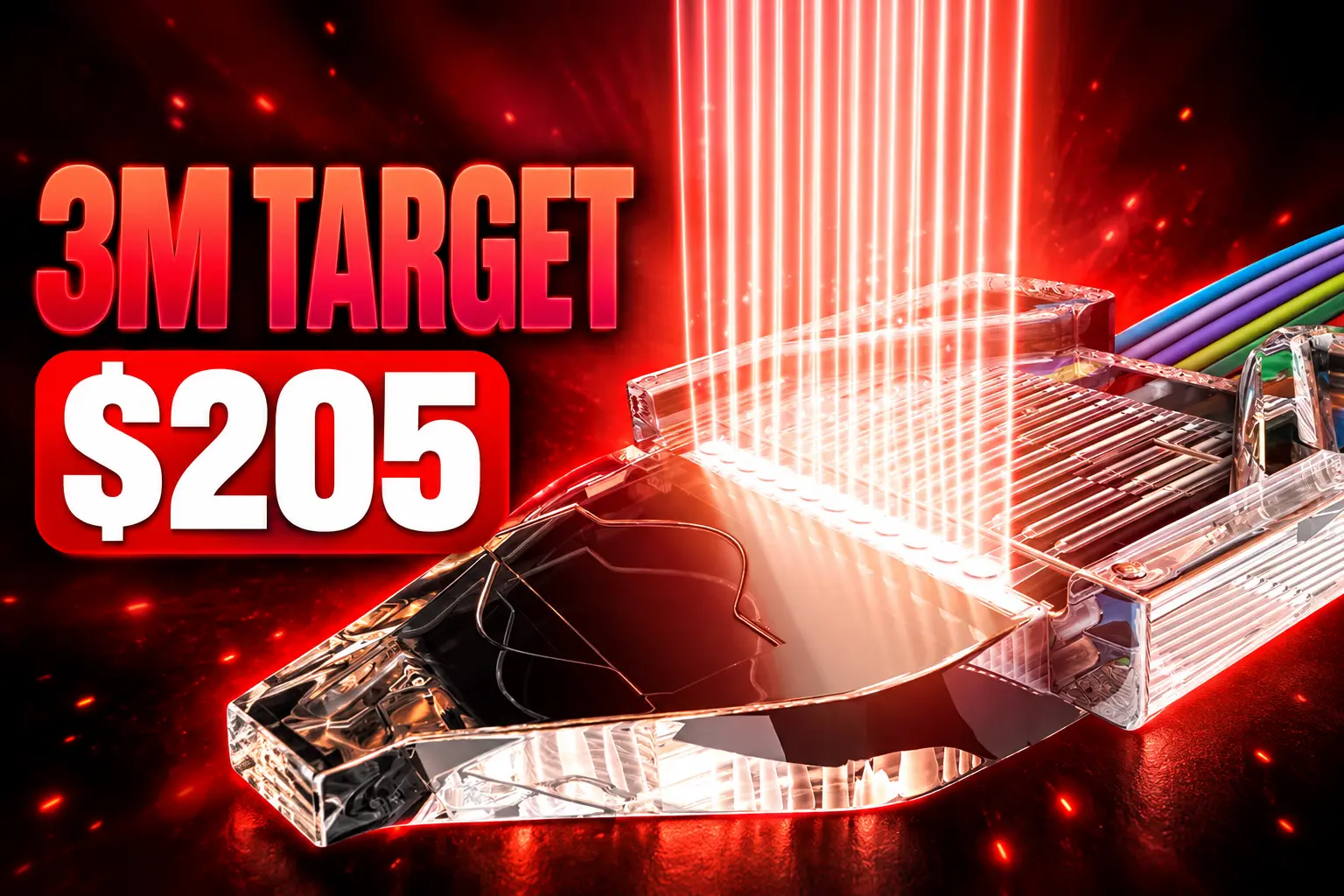
Two days before the upgrade, 3M and Microsoft announced the Azure optical partnership announced July 15. Microsoft’s Azure Cloud and AI Infrastructure becomes the first announced hyperscale cloud provider to deploy 3M Expanded Beam Optical technology. Traditional multi-fiber plugs need polished glass to kiss. EBO uses a lens array so the beam crosses a small air gap, which is why dust and handling hurt it less in a live hall.
WHAT 3M SAYS EBO CHANGES ON THE FLOOR
- Plug time: A conventional connector can take about three minutes; 3M’s kits cut plug-up time to about 30 seconds.
- A full install: One 3M case study put an MPO job at eight hours or more and the same run with EBO at about one hour, with months of traffic and no reported errors.
- Circuit time: Chairman and CEO William Brown told investors the design can cut time to install circuits in a data center by about 85%.
- Density: Kits cover 12-fiber, 16-fiber, and 144-fiber single-mode and multimode systems.
Brown also put 2026 EBO revenue in a $40 million to $50 million band, with about 100 patents and 50 pending. In June he described the broader inside-the-data-center book, copper TwinAx plus EBO, as about $100 million. Against a company that just did $6.5 billion of sales in one quarter, that optical line is about two tenths of a percent of annualized revenue. It is a real product. It is not yet a real earnings driver.
3M’s EBO solution will help unlock new levels of performance, reliability and efficiency to ensure customers can run their cloud and AI workloads on a trusted, sustainable and advanced environment.
Cliff Henson, corporate vice president, Cloud Supply Chain, Microsoft, July 15 joint release
3M is trying to make that quote scale. On March 16 it said a U.S. plant add would more than double EBO production capacity, after the product went into mass production in late 2024. Brown has said a second hyperscaler is still in testing and that big cloud buyers will not live with a single source. A 44-member multi-source group that includes Microsoft, Nvidia, Meta, AMD, Oracle, and Foxconn is the attempt to turn a 3M part into an industry interface. Until other vendors ship compatible volume, Azure is a reference customer, not a standard.
The same pact runs the other way. 3M is putting Microsoft AI into customer service, finance, sales, and marketing, and Microsoft Frontier Company engineers are building an agent workflow for credit checks and delinquent accounts inside Global Business Services. That is a cost and cash-cycle project. It is not the thing Katoku is asking investors to pay for.
Industrial Demand Carried the Second Quarter
The print that let JPMorgan jump from $180 to $205 was a factory quarter, not a fiber quarter. On July 21, 3M reported GAAP sales of $6.5 billion, up 2.4% from $6.344 billion a year earlier. Adjusted organic sales rose 5.4%. GAAP earnings were $1.78 a share, up 33% from $1.34. Adjusted earnings were $2.40, up 11% from $2.16. Adjusted operating margin reached 24.9%, up 40 basis points, which Brown called about 25% and the highest the company has reported. GAAP margin fell 290 basis points to 15.1%, mostly because of a $0.61 loss on divestitures and $0.44 of net costs for litigation and the PFAS exit, partly offset by a $0.60 lift from the remaining Solventum stake.
Q2 2026 AGAINST THE NEW YEAR GUIDE
| Item | Q2 2026 | Full-year 2026 now |
|---|---|---|
| Adjusted organic sales | 5.4% | Greater than 3.5% (was about 3%) |
| Adjusted EPS | $2.40, up 11% | $8.80 to $8.95 (was $8.50 to $8.70) |
| Adjusted operating margin | 24.9%, up 40 bps | Expansion of 70 to 80 bps |
| Cash | $1.3B adjusted free cash flow; $1.4B returned | $5.8B to $6.0B adjusted operating cash flow, conversion above 100% |
Safety and industrial organic sales rose 8.2%. Transportation and electronics rose 5.9% organically, with semiconductor, aerospace, data center, advanced materials, and commercial branding doing the lifting. Those semiconductor, aerospace, and data-center lines are about 20% of sales and grew at a double-digit pace. Transportation grew about 5%. Auto was flat. Consumer electronics was down low single digits. China sales rose at a double-digit rate in the quarter and about 8% in the first half. The year guide now also calls for adjusted total sales growth greater than 4.5%. The earnings midpoint moved about 27 cents. Oil inflation of $150 million to $175 million is already in that frame.
Brown put the quarter in operating language, not optical language.
We delivered a strong second quarter, exceeding expectations with mid-single-digit sales growth, robust operating margins of about 25%, and double-digit EPS growth, reflecting the progress we’re making on our strategic priorities and building a higher-performing company.
William Brown, chairman and CEO, 3M, July 21 earnings release
Scott Safety Cash Landed on July 1
Katoku’s buyback argument needed a check. On March 19, 3M said it would team with Bain Capital to buy Madison Fire & Rescue from Madison Industries for $1.95 billion and fold it together with Scott Safety, the breathing-apparatus line used by firefighters. 3M contributes Scott Safety, takes $700 million in cash at close, and owns 50.1% of the new company. Bain owns 49.9%. The deal closed on July 1. Full-year guidance still does not include it.
For the second half, 3M’s model pack points to about $450 million of combined sales, roughly $200 million from Madison and $250 million from the Scott breathing-apparatus book, and about $200 million of incremental sales at 3M. Brown called safety a priority vertical and said the wider reach should help margins and free cash flow. That $700 million is dry powder for the share-count cut JPMorgan wants. It is also a reminder that 3M is still rearranging the portfolio years after the Solventum health-care spin.
Around the same week as the upgrade, 3M also signed a long-term insulation deal with Airbus for the A220 and launched Ask 3M, an AWS-powered assistant for product specs. On August 17 it replaced its revolver with a new $4.25 billion unsecured facility, with JPMorgan Chase Bank as administrative agent. None of those items move 2026 earnings the way the 5.4% organic print did.
PFAS Charges and a Split Street Still Weigh
The Overweight has to clear a ledger that did not vanish when Azure took the connectors. Q2 still carried $0.44 a share of net costs for significant litigation and the PFAS exit. GAAP margin compressed even as the adjusted margin made a record. Auto and consumer electronics are still the drag Katoku said datacenter demand would offset. EBO capacity is supposed to double around year-end, and hyperscalers will not accept a single source, which means 3M has to help other makers stand up before the MSA is more than a membership list.
WHERE ANALYSTS DISAGREE
- The bull tape: UBS, through Damian Karas, is at $218. Argus is at $205, matching JPMorgan’s new number. Goldman Sachs is at $202.
- The hold tape: Mizuho’s Brett Linzey is Neutral at $180. Citigroup’s Andrew Kaplowitz is Neutral at $183. Morgan Stanley is Equal Weight at $189.
- The skeptic tape: RBC’s Deane Dray is Underperform at $132, the low on the live range against UBS at the high.
That spread is the market’s honest read of Katoku’s bet. Fifteen analysts average $177.21, which is closer to the September 8 close than to $205. Optics people on X treated the Azure qualification as a genuine interconnect win and then immediately sized it as a $40 million to $50 million 2026 book. They have the physics right and the income statement right. Dust-tolerant beam expanders can shave hours off a fiber plant. They cannot, at this scale, carry a conglomerate multiple by themselves.
JPMorgan got the first move. 3M cleared $180 and the high-water mark at $184.90. The shares then spent August and early September giving that impulse back, while the $205 target stayed on the note. The rest of the wager is whether industrial organic growth stays above 3.5% through October 20, and whether Azure’s EBO line is still a rounding error by the time capacity doubles.
Disclaimer: This article is news reporting and analysis of analyst ratings, company filings, and market prices. It is for information only and is not investment advice, a recommendation to buy or sell 3M or any other security, or a forecast of future returns. Readers should consult a licensed financial adviser or broker who can review their own objectives, time horizon, and risk tolerance before acting. Share prices, price targets, earnings figures, and deal terms are those published by the cited companies, filings, and data services as of the dates named in the piece and can change without notice.

Windows 11 26H2 Turns Settings Backup On by Default

The Gears 2 PC Port Epic Refused to Ship

Ghost Recon Wildlands Returns at 4K as a Catalog Product

Waterpark Simulator Keeps the $12.99 Price After 1.0

Nurix Puts NuPlay on Microsoft Marketplace to Reach Azure Buyers

Warzone Leaves Xbox One and PS4 After Season 06

Microsoft AI Was Set Free to Build Its Own Frontier

Microsoft IQ Turns Workplace Data Into a Metered Agent Brain

Xbox Games Showcase 2026 Split the Catalog in Two

Nadella Banned Addiction Talk While Scout Kept Heartbeat
-
 NEWS4 months ago
Warzone Leaves Xbox One and PS4 After Season 06
-
 NEWS4 months ago
Microsoft AI Was Set Free to Build Its Own Frontier
-
 MICROSOFT 3654 months ago
Microsoft IQ Turns Workplace Data Into a Metered Agent Brain
-
 NEWS4 months ago
Xbox Games Showcase 2026 Split the Catalog in Two
-
 MICROSOFT 3654 months ago
Nadella Banned Addiction Talk While Scout Kept Heartbeat
-

 NEWS4 months ago
Modern Warfare 4 Splits Its Audience Before the October Launch
-

 NEWS4 months ago
Infinity Ward Bets Modern Warfare 4 on a Paid DMZ
-

 NEWS4 months ago
Dragonwilds Hits Xbox, but Steam Saves Stay Put