
AZURE
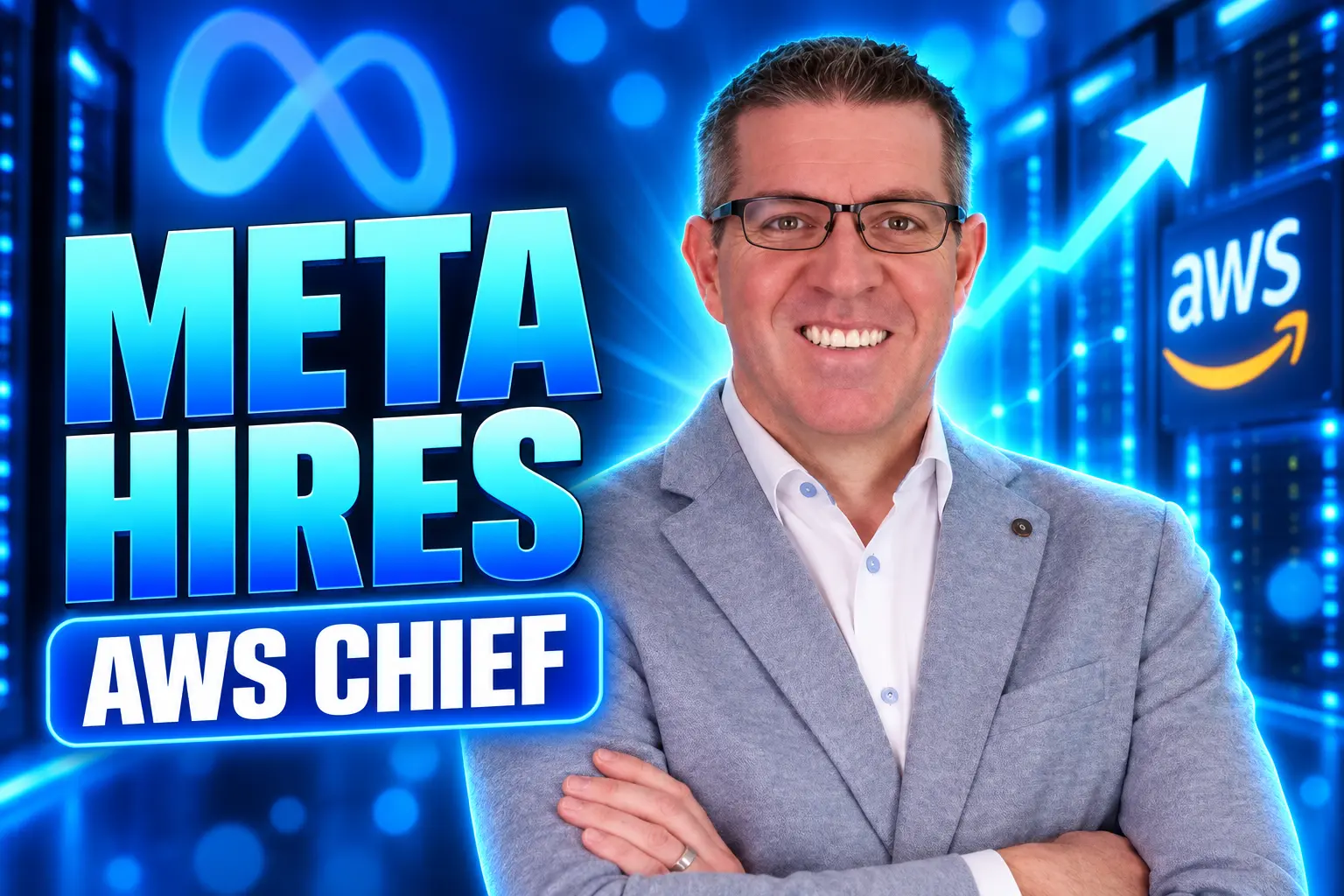
Meta Hires AWS Compute Chief Dave Brown for AI Factories
Dave Brown left Amazon’s compute group for Meta’s AI factories, a hire that underwrites Zuckerberg’s bet on surplus compute, not a finished Azure rival.

Dave Brown, Amazon Web Services’ compute and machine-learning chief, left after nearly 19 years to join Meta’s data-center build-out. People familiar with the matter said he will report to infrastructure head Santosh Janardhan and help run factories funded at $130 billion to $145 billion this year. Meta has not put his name on an earnings call.
The hire is being treated in the market as a fourth cloud brand. The job on paper is to keep Mark Zuckerberg’s construction program standing, and to leave the door open to rent spare capacity if the labs ever have any.
The EC2 Builder Walks Into Menlo Park
AWS CEO Matt Garman told staff on July 15, 2026, that Brown had taken a new role outside the company after nearly 19 years, starting in Cape Town and finishing in Seattle. Garman asked him to stay through the end of July so Dave Treadwell, then senior vice president of eCommerce Foundation, could take Compute and ML Services on August 1.
Brown’s own note is the cleanest record of what he actually did. He came in as a developer on the Elastic Compute Cloud service, the rental-server product that turned Amazon’s spare capacity into a business, and left as SVP of Compute and Machine Learning Services, the group that still sits on that stack.
From my early days as a developer working on EC2, not really understanding what it would become, to having the opportunity to work alongside so many incredibly talented people building technology that millions of customers around the world rely on every day, it has been an extraordinary journey.
Dave Brown, SVP, AWS Compute and Machine Learning Services, in his July 15 staff note
That line is why the Meta reading runs ahead of the org chart. Brown did not run a campus electrical team. He ran the group that turns servers into something other companies can buy by the hour, including Amazon’s later AI hosting products. If Zuckerberg wants a customer cloud, that is the muscle he bought. If he only wants his own training clusters to stay up, that is still the same muscle.
Amazon did not name Meta in the memo. Two days later, people familiar with the matter said Brown would join Meta’s infrastructure organization and focus on the data-center build-out. Meta’s press office has not issued a matching statement.
A Three-Person Cabinet for Tens of Gigawatts
Brown is walking into a structure Zuckerberg already named. On January 12, 2026, the CEO used Threads to launch Meta Compute, a top-level push to plan how the company would add power and halls at a scale social apps never needed.
https://www.threads.com/@zuck/post/DTa3-B1EbTp
“Meta is planning to build tens of gigawatts this decade, and hundreds of gigawatts or more over time,” he wrote. “How we engineer, invest, and partner to build this infrastructure will become a strategic advantage.”
THE META COMPUTE LEADS
- Santosh Janardhan: Head of global infrastructure since 2009, he owns technical architecture, the software stack, the silicon program, developer tools, and the global data-center fleet and network, and he is the manager Brown is expected to report to.
- Daniel Gross: The Safe Superintelligence co-founder who joined Meta last year, he runs long-term capacity strategy, supplier partnerships, industry analysis, planning, and business modeling.
- Dina Powell McCormick: President and vice chairman, she works with governments on building, deploying, investing in, and financing the plants.
That split tells you what Brown is not. He is not the government-relations lead and he is not the person modeling decade-long power deals. He is the operator who has already taken a rental-compute product from a Cape Town engineering outpost to a global service. Janardhan still holds the fleet. Brown is the person hired to make that fleet behave like something a stranger could rent.
Keeping Blackwell-class clusters from tripping a regional grid is the unglamorous half of that brief. Selling leftover flops is the half investors keep pricing. Both need the same discipline: multi-tenant isolation, boring uptime, and a bill that a customer will pay twice.
$784 Million Is What the Quarter Left
The wager is already visible in cash. Meta’s July 29 results for the quarter ended June 30 showed a social business that is still growing and a construction program that is using almost every dollar that business throws off.
META’S SECOND-QUARTER CASH AND GUIDE
| Item | Figure |
|---|---|
| Revenue | $60.80 billion, up 28% |
| Operating cash flow | $31.86 billion |
| Capital expenditures | $31.08 billion |
| Free cash flow | $784 million |
| Free cash flow a year earlier | $8.55 billion |
| 2026 capex outlook | $130 billion to $145 billion |
Free cash flow of $784 million is down 91% from $8.55 billion a year earlier. Cash, cash equivalents, and marketable securities were $90.26 billion on June 30. Long-term debt was $83.66 billion. Operating margin compressed to 31% from 43%, and income from operations fell 8% to $18.775 billion, even as Family daily active people reached 3.60 billion, up 3%.
The capex range itself moved twice. Meta opened 2026 at $115 billion to $135 billion, lifted that in April to $125 billion to $145 billion on component prices and more hall costs, then on July 29 raised the floor to $130 billion and left the ceiling at $145 billion. Full-year expenses are now $165 billion to $169 billion, after $2.40 billion of legal charges and $1.18 billion of severance from the May headcount cut. Headcount was 75,472, a figure that still included about 8,000 people from that cut.
Zuckerberg used the same release to pitch a second act. “AI is accelerating our core business today, powering our next generation of products, and opening the door to entirely new enterprise opportunities,” he said. The enterprise line is the hedge. If the halls train Muse Spark and feed ads, they are a cost. If they also serve large outside customers, they are a product. Brown is the hire that makes the second sentence sound operational rather than rhetorical.
Anthropic Talks Put a Customer on the Calendar
The first named outsider in that hedge is Anthropic, the Claude lab. People familiar with the matter said in mid-July that the two sides were in early talks for Meta to rent computing power, with figures around the talks reaching as high as $10 billion, after Anthropic floated the idea in June. No contract has been announced.
On the July 29 call, Zuckerberg said Meta was getting offers for compute at a significant premium to what it paid to build the capacity, and that a large share of the iron would still go to training, the core apps, and personal agents. He also said the company expects to grow a large business serving large customers, while arguing that selling intelligence should carry a higher margin than selling raw compute. At the May shareholder meeting he had already called a cloud business “definitely on the table,” and said outside firms were coming in almost every week asking for an API or for spare capacity at a markup. He added that Meta had not done those deals yet because it still had a use for the compute, with overbuild as the option if that ever flipped.
WHAT WE KNOW
- Amazon’s record: Brown left AWS at the end of July and Treadwell took Compute and ML Services on August 1, per Amazon’s own staff notes.
- The Meta brief: People familiar with the matter said Brown will report to Janardhan and work on the data-center build-out inside Meta Compute.
- The money: Meta guided 2026 capital spending to $130 billion to $145 billion and posted $784 million of free cash flow in the second quarter.
WHAT IS UNCONFIRMED
- A Meta statement: The company has not issued its own release naming Brown or defining a cloud P&L he would run.
- The Anthropic lease: Talks to rent capacity, including a figure as high as $10 billion, remain early and unsigned.
- A public cloud SKU: Raw GPU rental versus hosted models is still a live internal choice, not a price list.
That last gap is the one a compute chief cannot close alone. EC2 became a business because Amazon wrapped the servers in accounts, regions, SLAs, and a sales force. Meta can pour concrete without any of that. It cannot collect a premium from Anthropic, or from anyone else, until the iron looks like a product a lab will bet a training run on.
What the Hire Changes for Microsoft Azure
Amazon, Microsoft, and Google already sell this product. Meta is the large U.S. builder that has not. Azure’s near-term risk is not a new portal with a gradient logo. It is Meta turning from an overflow tenant into a wholesale seller of the same scarce GPUs, while still training its own models on halls it owns.
The first bruises land with the neoclouds that still bill Meta for rented clusters, because those contracts exist to cover the gap until Meta’s own sites catch up. Azure’s enterprise book, the one tied to Microsoft 365, GitHub, and long-running Windows estates, does not reprice because Janardhan hired an EC2 veteran. Azure’s GPU queue does, if Meta starts clearing leftover training capacity into the same buyers Microsoft wants for its own dedicated-host and AI-factory SKUs.
Brown’s Bedrock-era years matter more to that wholesale fight than to a console war. Hosted models on Meta’s iron, including the company’s own, would look less like a second Azure and more like a second place to buy inference without going through Microsoft’s stack. Zuckerberg has already said intelligence should pay better than raw compute. That is a product thesis Azure already lives on. It is not one Meta has shipped.
Amazon Handed Compute to a Windows Veteran
The other half of the trade sits in Seattle. Treadwell took Brown’s seat on August 1. Amazon’s own profile of him says he spent 27 years at Microsoft after Princeton, as part of a small group of coders behind early Windows, and that he expected to stay until a 2016 meeting with then stores chief Jeff Wilke pulled him to Amazon’s e-commerce platform. He has run that platform, including Prime Day availability, for about a decade.
https://x.com/AWSNewsroom/status/2077820580070412379
Treadwell told Amazon he sees the current AI shift as bigger than computers, the internet, mobile phones, and cloud computing. He is a scale-and-uptime executive, not an EC2 founder. Amazon is betting that running one of the world’s largest retail platforms is enough of a rehearsal for the compute and ML organization Brown left. Meta is betting the inverse: that the person who helped make EC2 a product is the person you want when you are about to find out whether $31.08 billion a quarter of halls can do more than train your own models.
Shares in Meta fell about 10% after the July 29 print, a reminder that investors will fund the factories only so long as the second act stays plausible. Brown does not make Azure cheaper next quarter. He makes it harder to argue that Meta is only pouring money into empty rooms.
The Dates Behind the Compute Wager
HOW THE BET WAS STAFFED
- January 12, 2026: Zuckerberg launches Meta Compute on Threads and names Janardhan, Gross, and Powell McCormick to plan tens of gigawatts this decade.
- April 29, 2026: Meta lifts 2026 capital spending guidance to $125 billion to $145 billion, citing component prices and more data-center cost.
- May 2026: At the shareholder meeting, Zuckerberg calls a cloud business definitely on the table and describes weekly inbound asks for APIs and spare compute.
- July 15, 2026: Garman tells AWS staff Brown is leaving; Treadwell is named to Compute and ML Services effective August 1.
- July 17, 2026: People familiar with the matter say Brown will join Meta under Janardhan; the same week, early Anthropic rental talks surface.
- July 29, 2026: Meta reports $784 million of free cash flow, $31.08 billion of capex, and a narrowed 2026 range of $130 billion to $145 billion, while Zuckerberg talks of a large business serving large customers.
- August 1, 2026: Treadwell takes the AWS compute seat Brown held. Meta still has not posted its own confirmation of Brown’s arrival.
Amazon closed Brown’s file at the end of July. The construction bill did not wait for a welcome post. Until Meta names him, and until a lab signs for a block of its GPUs, the hire is still what the memos say it is: an operator moved onto the most expensive factories the company has ever built, with a customer cloud as the option those factories are supposed to keep alive.
Disclaimer: This article is news reporting and analysis of a management hire and related company filings, and it is informational only. It is not investment advice, a recommendation to buy or sell Meta, Amazon, or Microsoft securities, or a forecast of any cloud-revenue outcome. Readers who are considering a position in these companies should consult a licensed financial adviser who can review their own holdings, time horizon, and risk limits. The figures and statuses here reflect the Amazon staff notes, Meta’s July 29, 2026 results, and other sources cited in the piece, and they can change with later filings, contracts, or confirmations.

Windows 11 26H2 Turns Settings Backup On by Default

The Gears 2 PC Port Epic Refused to Ship

Ghost Recon Wildlands Returns at 4K as a Catalog Product

Waterpark Simulator Keeps the $12.99 Price After 1.0

Nurix Puts NuPlay on Microsoft Marketplace to Reach Azure Buyers

Warzone Leaves Xbox One and PS4 After Season 06

Microsoft AI Was Set Free to Build Its Own Frontier

Microsoft IQ Turns Workplace Data Into a Metered Agent Brain

Xbox Games Showcase 2026 Split the Catalog in Two

Nadella Banned Addiction Talk While Scout Kept Heartbeat
-
 NEWS4 months ago
Warzone Leaves Xbox One and PS4 After Season 06
-
 NEWS4 months ago
Microsoft AI Was Set Free to Build Its Own Frontier
-
 MICROSOFT 3654 months ago
Microsoft IQ Turns Workplace Data Into a Metered Agent Brain
-
 NEWS4 months ago
Xbox Games Showcase 2026 Split the Catalog in Two
-
 MICROSOFT 3654 months ago
Nadella Banned Addiction Talk While Scout Kept Heartbeat
-

 NEWS4 months ago
Modern Warfare 4 Splits Its Audience Before the October Launch
-

 NEWS4 months ago
Infinity Ward Bets Modern Warfare 4 on a Paid DMZ
-

 NEWS4 months ago
Dragonwilds Hits Xbox, but Steam Saves Stay Put