
NEWS
Windows 11 Store Speed Fix Undoes a Windows Update Habit
KB5094126 sped up Microsoft Store downloads in Windows 11 by changing a polite Windows Update bandwidth stack that had capped Store transfers for years.

Windows 11’s June 9, 2026 patch, KB5094126, made Microsoft Store downloads use more of the PC’s bandwidth. Microsoft described only “underlying changes that improve download performance and bandwidth usage.” The Store had been pulling files through the same polite stack Windows uses for updates, so a click on Update often crawled while a browser on the same line finished the same bytes in a couple of minutes.
The notes barely mentioned it. Anyone who already left for Steam, a browser installer, or winget will only see the difference if they still open the Store.
The June Patch Speeds Up Store Downloads
The June 9 cumulative for Windows 11 is the mandatory Patch Tuesday package for versions 25H2 and 24H2. It also rolls in the May 12 security drop (KB5089549) and the May 26 optional preview (KB5089573). Microsoft’s Store notes in this cycle cover two things: download performance and bandwidth usage, and clearer errors when a Windows Update Group Policy blocks a Store install.
THE JUNE 9 BUILDS
- Package: KB5094126, the June 2026 Patch Tuesday cumulative for Windows 11.
- 25H2: OS build 26200.8655 after the update is installed.
- 24H2: OS build 26100.8655 on the same day.
- Store notes: download performance and bandwidth usage, plus better Group Policy error reporting.
The June support page we read spends its Improvements list on Secure Boot certificates, a Hyper-V stop error, folder icons, and DISM. The Store work is easy to miss if you only skim the bold items.
This update includes underlying changes that improve download performance and bandwidth usage.
Microsoft, Windows 11 KB5094126 Store notes
Microsoft did not name the component it changed. It did not say BITS. It did not say Delivery Optimization. It did not publish a before-and-after speed chart. The practical result showed up in everyday Update clicks: transfers that used to stall or sit in Pending started moving and stayed moving.
On a 1 Gbps link, Steam has been finishing a full game in about ten minutes while the Store sat between 200KB/s and 4MB/s on the same PC. A 500MB app update could take twenty minutes in the Store and under two minutes in a browser. After the June patch, a 700MB CapCut update on a 30Mbps hotel connection held about 3MB per second with no pauses, which is most of that line.
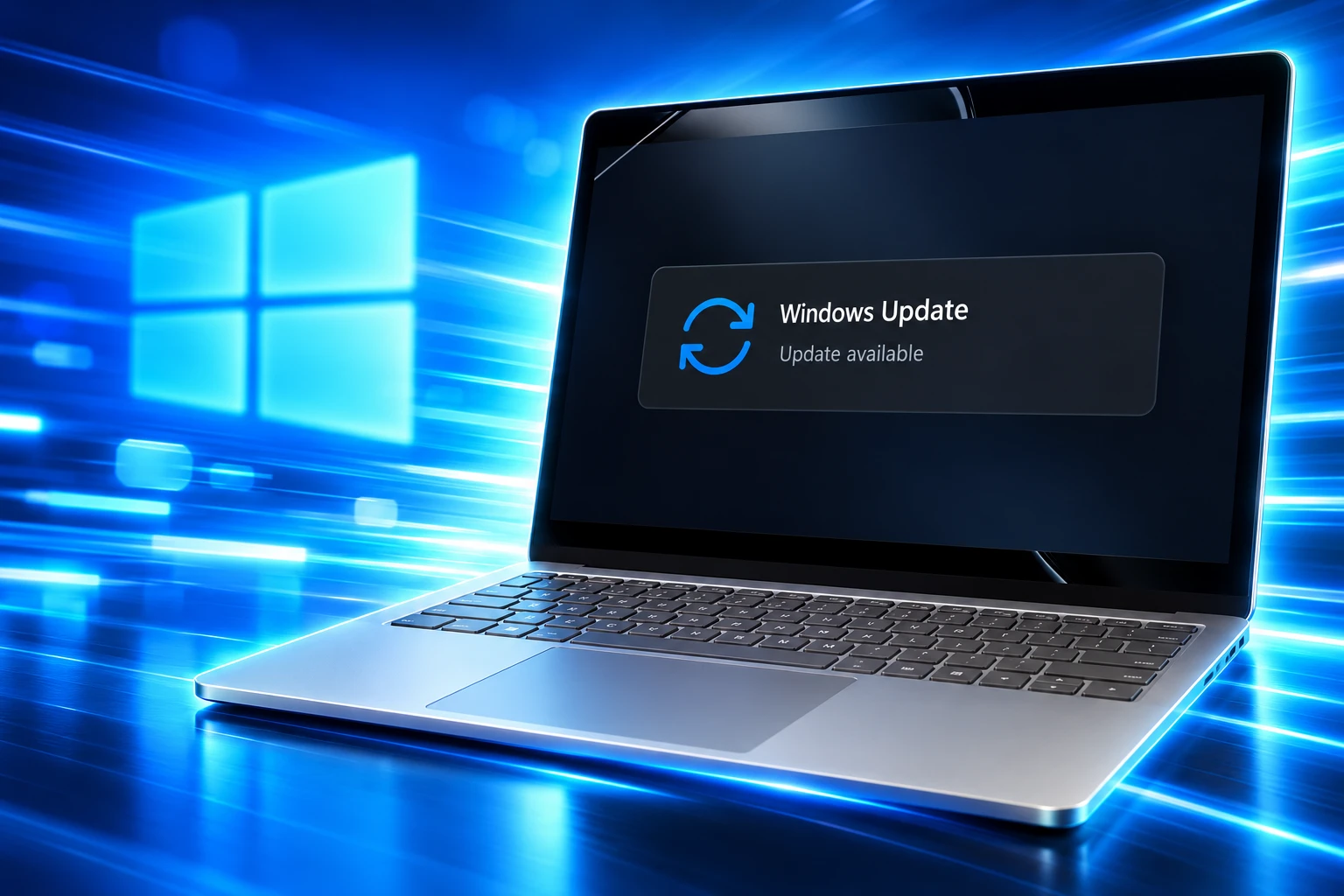
A Polite Downloader From Windows XP
Windows has spent two decades teaching its own downloaders to get out of the way. Background Intelligent Transfer Service shipped with Windows XP as the engine for Windows Update. It was built to sip leftover bandwidth, pause when a browser needed the line, and resume after a reboot.
BITS uses idle network bandwidth to transfer the files and will increase or decrease the rate at which files are transferred based on the amount of idle network bandwidth available. If a network application begins to consume more bandwidth, BITS decreases its transfer rate to preserve the user’s interactive experience.
Microsoft, About BITS, Microsoft Learn
That is a good design for a Tuesday quality update on a shared office pipe. It is a poor design for a storefront that is competing with Steam and a Chrome download button. Foreground BITS jobs can run harder, but the default instinct is still politeness.
Delivery Optimization later became the HTTP downloader for Windows updates, Store apps, and other Microsoft products. Consumer docs still say Windows uses that cloud downloader to fetch Windows Updates, apps from the Store, and other Microsoft products. The Store never got a separate, greedy client. It got the update client with a storefront painted on top.
FROM IDLE BANDWIDTH TO A JUNE PATCH
- Windows XP: BITS ships as a throttled, resumable downloader that uses idle bandwidth so Windows Update does not tramp on a web browser.
- Windows 10 1511: UWP Store apps move onto Delivery Optimization, the same HTTP downloader Windows Update uses, with optional peer sharing and Connected Cache.
- May 26, 2026: Optional preview KB5089573 ships; the June 9 cumulative later includes that preview package.
- June 9, 2026: KB5094126 reaches 24H2 and 25H2 as Patch Tuesday, with Store notes on download performance and Group Policy errors.
- July 23, 2026: An Azure incident takes Windows Update, the Microsoft Update Catalog, the Microsoft Store, and WSUS down together for part of the afternoon Pacific time.
Years of “fix slow Store” guides all pointed at the same Settings page: Windows Update, Advanced options, Delivery Optimization. People unchecked background and foreground caps, typed huge Mbps numbers, or turned off downloads from other PCs. The Store was not a unique broken CDN. It was obeying the update stack’s manners.
Why Store Downloads Sat at a Fraction of Gigabit
Microsoft still publishes the default caps. Delivery Optimization aims to use no more than 45% of the available bandwidth on a background download, and 90% on an interactive, user-started foreground download. It retests the path every few minutes and eases off when the network is busy. LAN peer transfers are the exception: those are not throttled.
A 30Mbps hotel line has a theoretical 3.75MB/s. Ninety percent of that is about 3.4MB/s, which sits next to the 3MB/s CapCut run after the patch. Forty-five percent would have been about 1.7MB/s. The old 200KB/s to 4MB/s band on gigabit fiber sat far below even the background default, which is why the June change felt like someone had taken the parking brake off rather than upgraded the NIC.
Not every Store payload gets the same help from peers. Microsoft’s own content map is uneven, and that still matters after the speed work.
WHAT THE STORE SHARES WITH WINDOWS UPDATE
| Payload | HTTP downloader | Peer sharing | Connected Cache |
|---|---|---|---|
| UWP Store apps | Yes, since Windows 10 1511 | Yes | Yes |
| Win32 Store apps on Windows 11 | Yes | No | No |
| Windows Update | Yes | Yes | Yes |
| Windows Package Manager (winget) | Yes | No | No |
A UWP app can pull pieces from nearby PCs. A Win32 Store app on Windows 11 cannot. Winget sits on the same HTTP downloader with no peer assist. If the June work only raised how hard a foreground Store job is allowed to pull from Microsoft’s HTTP source, Win32 titles gain speed and still miss the LAN shortcut UWP apps already had.
Admins who set Delivery Optimization DownloadMode to 100 (Bypass) are on a dead path. Microsoft has deprecated that mode on Windows 11, and some content then fails with 0x80d03002. Turning off peer sharing (mode 0) still lets the HTTP downloader run. The Store does not leave this stack just because you hate P2P.
The WSUS Policy That Blocks Store Installs
The second Store change in KB5094126 is smaller and, for helpdesks, more useful. Microsoft said the update “improves error reporting when downloads fail due to Windows Update group policy settings being enabled.” It does not lift the block. It names it.
On managed PCs the Store has long failed with “This install is prevented by policy. Ask your admin to enable Windows Update” and code 0x8024500C. Kimberly Olaño, answering on Microsoft Q&A, put the coupling in one line: the Store relies on the Windows Update service to handle the actual download and installation process. When Group Policy starves that service, the catalog can still browse and the install still dies.
POLICIES THAT SILENCE THE STORE
- Internet locations: Enabling “Do not connect to any Windows Update Internet locations” can cause the Microsoft Store to stop working, along with Windows Update client policies and Delivery Optimization.
- Intranet WSUS: “Specify intranet Microsoft update service location” is the partner policy that points devices at an internal update server; the internet-locations policy only applies when that intranet policy is in use.
- The old message: Users saw 0x8024500C and a generic “ask your admin” line, with no policy name to search.
- The June change: The Store is supposed to point at the relevant Windows Update Group Policy instead of a blank failure.
Schools and firms that keep WSUS or Configuration Manager as the only update source often flip that internet-locations policy so PCs cannot wander out to public Windows Update. The side effect is a dead Store. The June text is for the admin who has to explain why Company Portal and Paint never install, not for the person who just wants CapCut in a hurry.
July’s Azure Outage Hit the Same Pipes
Seven weeks after the patch, the shared plumbing showed up the hard way. On July 23, 2026, Microsoft posted that an Azure outage was affecting several Windows services. The list was Windows Update, the Microsoft Update Catalog, Microsoft Store downloads, and Windows Server Update Services. The notice went up around 11:15 a.m. Pacific. Microsoft said those Windows services were back to normal around 1:45 p.m. Pacific.
A storefront with its own CDN would have kept selling apps while Windows Update coughed. This one did not. Store payloads, quality updates, and WSUS traffic still meet in the same Microsoft cloud front door. Faster client-side bandwidth use does not invent a separate Store network. It only changes how hard the PC pulls once the path is up.
That is also why a “Store is slow” ticket still belongs next to a Windows Update ticket. If Delivery Optimization is capped, if the NIC is marked metered, or if a WSUS policy is on, the Store inherits the limit. KB5094126 changed the default manners. It did not split the service.
Faster Downloads Leave a Clunky Store Window
The remaining complaint is the window around the progress bar. The Store is still a UWP app. Scrolling the library hitch-steps. Switching tabs lags. On a phone, the Play Store keeps 60fps while a Windows 11 laptop’s Store drops frames. File Explorer already showed the split: the WinUI pieces scroll smoothly, and the older pieces do not.
A WinUI 3 rebuild would likely fix that, but WinUI 3 still had a black screen-tearing bug on resize into summer 2026, with a fix then promised. Until the Store itself is rebuilt, a fast download dumps you back into a slow catalog. The June patch never claimed to touch that.
The sharper problem is habit. Replies to the June speed news were less “finally” and more “who still uses the Store.” People who needed a full-speed client already had Steam, GitHub releases, and winget. In August, at least one PC gamer said Store game installs were beating Steam on their line, then immediately complained that the catalog is thin next to the Xbox storefront. Speed was the embarrassing excuse. Catalog depth and the UWP shell are what is left.
Microsoft never published the diff. The documented history is still sitting in Learn: idle-bandwidth BITS, then Delivery Optimization at 45% in the background and 90% in the foreground, with the Store listed as just another caller. KB5094126 is the first time in years that a Patch Tuesday note admitted the Store’s bandwidth behavior was wrong. The pipe is the same one Windows Update uses. It is just allowed to run hotter when you click Install.
Frequently Asked Questions
How Do I Check That Windows 11 Has the Store Speed Fix?
Open Settings, then System, then About, and read the OS build. 25H2 should show 26200.8655 or later, and 24H2 should show 26100.8655 or later. Any later monthly cumulative already contains the June Store work, because those packages supersede KB5094126 rather than shipping beside it.
Does Turning Off Delivery Optimization Stop Microsoft Store Downloads?
Microsoft says no. Delivery Optimization is the HTTP downloader the Store already uses, so you cannot switch it off like a extra app. Set DownloadMode to 0 if you only want to kill peer sharing. Do not use mode 100 (Bypass) on Windows 11; that path is deprecated and can fail with 0x80d03002.
Will the June Error Text Unblock the Store on a WSUS PC?
No. The new reporting names the Windows Update Group Policy that is refusing the download. The install still fails until an admin changes “Do not connect to any Windows Update Internet locations” or another blocking update policy, or until the org allows Store traffic some other way, such as a private store or sideloading.
Where Do I Cap Store Download Bandwidth Myself?
Go to Settings, Windows Update, Advanced options, Delivery Optimization, then Advanced options. You can limit background and foreground transfers as a percent of measured bandwidth or as an absolute Mbps value. Those sliders apply to the same downloader the Store uses, which is why they were the long-time homemade fix before June.
Which Store Payloads Still Cannot Use Peer Sharing?
Win32 Store apps on Windows 11, Windows Package Manager installs, and MSIX installer content use Delivery Optimization’s HTTP path without peer-to-peer. Xbox Game Pass on PC can use Microsoft Connected Cache but is also listed without peer sharing. Only UWP Store apps get HTTP, peers, and Connected Cache together.
On a 30Mbps hotel link the CapCut update now finishes in about four minutes at 3MB per second. The product page still hitch-scrolls while you wait to click Install. That is the Store after KB5094126: the file transfer finally behaves like a foreground download, and the app around it still behaves like a UWP leftover.

Windows 11 26H2 Turns Settings Backup On by Default

The Gears 2 PC Port Epic Refused to Ship

Ghost Recon Wildlands Returns at 4K as a Catalog Product

Waterpark Simulator Keeps the $12.99 Price After 1.0

Nurix Puts NuPlay on Microsoft Marketplace to Reach Azure Buyers

Warzone Leaves Xbox One and PS4 After Season 06

Microsoft AI Was Set Free to Build Its Own Frontier

Microsoft IQ Turns Workplace Data Into a Metered Agent Brain

Xbox Games Showcase 2026 Split the Catalog in Two

Nadella Banned Addiction Talk While Scout Kept Heartbeat
-
 NEWS5 months ago
Warzone Leaves Xbox One and PS4 After Season 06
-
 NEWS5 months ago
Microsoft AI Was Set Free to Build Its Own Frontier
-
 MICROSOFT 3655 months ago
Microsoft IQ Turns Workplace Data Into a Metered Agent Brain
-
 NEWS5 months ago
Xbox Games Showcase 2026 Split the Catalog in Two
-
 MICROSOFT 3655 months ago
Nadella Banned Addiction Talk While Scout Kept Heartbeat
-

 NEWS5 months ago
Modern Warfare 4 Splits Its Audience Before the October Launch
-

 NEWS5 months ago
Infinity Ward Bets Modern Warfare 4 on a Paid DMZ
-

 NEWS5 months ago
Dragonwilds Hits Xbox, but Steam Saves Stay Put