
NEWS
Gravastar Reaches Xbox After a Decade With No Date
Studio Atma lists Gravastar on Xbox Series and Switch 2 after a 3D rebuild that cut one attack to eight hours, with price, publisher, and date still blank.

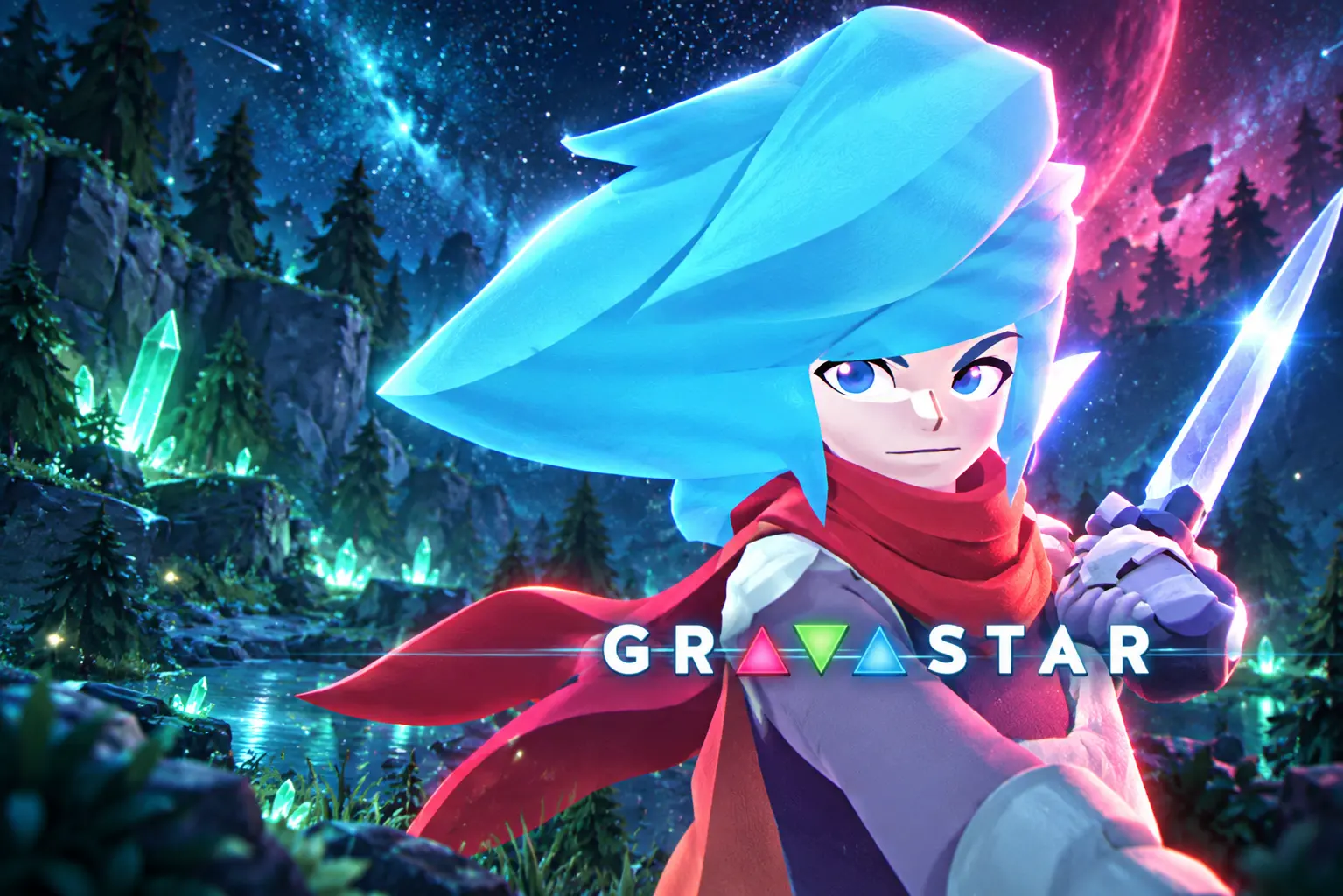
Studio Atma listed Gravastar for Xbox Series X and Series S, PlayStation 5, Switch 2, and PC on May 28, 2026, and left the ship date blank. The Seattle studio has been on the sci-fi JRPG for more than 10 years. Battles use combo inputs taken from 2D arcade fighting games.
The speed-up that was supposed to finish the work already happened. A single 2D attack that took a month now takes eight hours in 3D, and Steam still has empty fields where a date, a price, and a publisher belong.
Gravastar on Xbox Series, Switch 2, and PS5
Studio Atma’s own factsheet puts the studio in Seattle and marks both release date and price as TBD. The Steam page for app 4384590 matches that silence. It is a single-player RPG with achievements, cloud saves, and leaderboards, and it asks for Windows 10 or 11, an i3-class CPU, 8 GB of RAM, an Intel Iris 650 or Nvidia 1030-level GPU, and 20 GB of space.
Steam lists 11 languages. English has full audio and subtitles; French, German, Spanish (Spain), and Japanese get interface text and subtitles. You play Baird, an orphan on the exoplanet Aethera who learns he is a Spectre, a rare person whose power is tied to the stars, then sets out to stop a zealot who wants the universe in darkness.
GRAVASTAR IN BRIEF
- Campaign length: A story-driven run the studio puts at over 15 hours of classic JRPG play.
- Party size: Baird plus five playable companions, which the studio also pitches as six playable characters.
- Map: Five continents on Aethera, with field skills for puzzles and secrets.
- Look: 3D models animated like 2D, with hand-painted textures aimed at 16-bit and 32-bit JRPG memory.
The combo layer is the piece of Gravastar that has been public longest, and the fighting-game combat the studio chased is now the pitch for Xbox as well as Switch 2. Wishlisting is the only action the listing currently supports.
One Attack Took a Month, Then Eight Hours
Gravastar began in 2015 as a 2D game. The studio wrote a game design document of nearly 100 pages for the world, the cast, and the systems, and the overworld was meant to honor Capcom’s Breath of Fire 4. Combat was supposed to carry the snap of Marvel vs. Capcom 2. In June 2015 the studio still said the characters were 2D and that the bar was Capcom’s 2D arcade fighters, with 3D reserved for weapons or giant bosses that would be a nightmare to draw by hand.
That plan did not hold. The 3D rebuild exists because 2D production could not. The studio has shown a 2D attack, made with a tiny team and almost no budget, that took a month, and the 3D version of the same kind of attack, same constraints, that took eight hours. The written record of how one attack dropped to eight hours is the closest thing Gravastar has to a production thesis.
On November 14, 2018, the studio posted a short clip of the trick in public, under the line “Here’s how we make our 3D animation look more 2D.” People who watched it did not talk about platforms. They talked about charm, and at least one comparison went straight back to Breath of Fire IV, the same game the 2D build had been built to salute.
https://x.com/StudioAtma/status/1062518111671205888
The clip still reads as the moment Gravastar became a real object online. The 2026 trailer added a four-platform box and a wishlist button. It did not replace that 2018 test as the image people already had of the fight animations.
THE LONG ROAD TO A FOUR-PLATFORM LISTING
- 2015: Studio Atma writes a nearly 100-page design document for a 2D sci-fi JRPG.
- January 2, 2016: A first look at the battle system goes public, followed that May by a prototype and a Seattle Indies Expo demo.
- January 7, 2018: A new January 2018 gameplay demo shows overworld work and a rebuilt act list.
- November 14, 2018: The studio posts the 3D-to-2D animation breakdown.
- February 1, 2019: A field-skills update describes Baird throwing his weapon to stun enemies on the map.
- May 28, 2026: Gravastar is listed for current hardware, still without a date.
- June 4, 2026: The studio says the Steam page is live.
A June 2025 gameplay trailer was already in the studio’s public reel before the May 2026 listing. The “announce” is a store-page event, not the first time the game has been shown.
A Side Game Forced the Move to 3D
The 3D pipeline did not arrive as a clean cutover on Gravastar. After years of local shows and notes, the team hit burnout and parked the big JRPG for a smaller game about one character. That project, Erwin’s Retreat, casts a mourning, retired astrobotanist for the Teknos Corporation who has moved into remote woods and meets something he cannot explain. You use a lantern and elemental ammunition to solve puzzles and fight while hiking.
Erwin’s Retreat is where the studio rebuilt level design and production steps, then moved that work from 2D to 3D, including a new cel-shaded look, rigging, modeling, and texturing. Gravastar inherited that pipeline. The month-versus-eight-hours comparison is the studio’s own proof that the side game changed the math on a single swing.
Old work is still in the file. In June 2026, environment artist Anthony Garcellano, a former inXile and Vicarious Visions hand who had been off the project, recognized weapons in the new trailer and said he remembered making them years earlier. He wished the game on Steam and wrote that he was glad to see it come back. Assets that old surviving into a Switch 2 listing is a compliment to the art and a warning about the calendar.
The First Platform List Was Last-Gen Hardware
By early 2019 the public listing still named last-gen boxes. An IndieDB page for the game, last touched years before the 2026 trailer, put Gravastar on Windows, Xbox One, PlayStation 4, and Switch, running in Unity, with the same TBD release slot it has now. A March 2019 write-up of that plan also named Chrono Trigger and Final Fantasy as the tonal references around the combo fights.
WHERE GRAVASTAR WAS LISTED THEN AND NOW
| Family | 2019 listing | 2026 listing |
|---|---|---|
| PC | Windows | PC (Steam, Win 10/11) |
| Xbox | Xbox One | Xbox Series X and Series S |
| PlayStation | PlayStation 4 | PlayStation 5 |
| Nintendo | Switch | Switch 2 |
The count stayed at four. The hardware did not. Xbox players who bookmarked the One SKU are now staring at a Series listing with the same missing date. Nintendo’s line item jumped with the new handheld. Studio Atma did not announce a backward-compatible One or original Switch build with the 2026 factsheet.
That generation skip is the quiet Xbox story. A Seattle JRPG that once sat on Xbox One marketing lists now needs a current Series install, and there is still no day on the calendar to load it. The 2019 field-skills note, where Baird’s throw was in testing without finished animation, is the kind of overworld idea Steam still sells in 2026 as unique field skills for exploring, puzzles, and secrets. The verbs survived. The boxes did not.
What the Combo Battles Ask of You
Studio Atma calls the fights a fast, conditional turn-based system with an attack-combo input layer. You learn a character’s moveset, string chains, and try to change the pace of a round the way a 2D fighter does, without leaving the JRPG turn structure. Spells are framed as star power. The overworld is meant to be more than a path between random fights: each of the six playable characters is supposed to bring a field skill into exploration.
WHAT YOU ACTUALLY PLAY
- Combo turns: Button sequences sit on a turn clock, so a round can look like a short fighting-game exchange.
- Party of six: Baird and five companions travel together; the studio’s social pitch is “Find your companions. Find yourself. Kill God.”
- Five continents: Aethera is sold as a full-planet route, not a single dungeon corridor.
- Cel-shaded 3D: Hand-painted textures and 2D-style motion are the whole visual bet, not a filter on photoreal meshes.
Josh Speer played a Seattle Indies Expo demo in 2018 and came away stuck on the fights and the drawings.
the fighting game inspired combat really shines. In the demo I got to wander about, fighting in gloriously illustrated encounters […] I am continuously impressed by the artistry of Studio Atma
Josh Speer, after the 2018 Seattle Indies Expo demo
That demo is eight years behind the Xbox Series listing. The words still do more work than the 2026 press copy, which mostly repeats combo, stars, and nostalgia. If the eight-hour 3D swing looks like the 2018 tape, the combat pitch holds. If the extra years went into systems nobody has shown in a long session, the listing has not proved it.
Derek Blair’s Seattle Team Is Still Small
Creative director Derek Blair is listed as lead artist, animator, and lead designer. Robert Walker is lead software developer. David Goode covers narrative, levels, and writing. Chris Hurn composes; Joe Miller handles sound design; Elam Ein-Dor is the sound engineer; William Ofoegbu directs voice acting; Isaiah Montanez models in 3D. That is eight names on a game now promised to four current platforms.
The studio calls itself independent and still in development on Gravastar, its current JRPG. The factsheet’s joke about “grass-fed programmers who write only the most efficient and optimized code” is the only humor in an otherwise straight pitch. Awards on the same page all date to 2016 and 2018: iFest People’s Choice in 2016, official selection at Seattle Indies Expo in 2016 and 2018, MIX Seattle 2018, and iFest People’s Choice runner-up in 2018. There is no later festival line.
A four-platform Series, PS5, Switch 2, and PC plan is a lot of certification work for a roster that still reads like a local expo team. The art pipeline they built on Erwin’s Retreat is the reason that plan is even plausible. It is also why a missing publisher on Steam matters. Someone has to pay for those kits, those language passes, and the last miles of QA.
Publisher, Price, and Date Stay Blank
Steam’s publisher field is the blunt one. Developer is Studio Atma. The publisher still listed as TBD is not a hidden-name tease so much as an unfinished commercial setup. Price is TBD on the studio site. Date is “to be announced.” In the days after the May trailer, the studio told people watching a re-up of the clip that it was still waiting on Steam approval and expected the store page that week. The page arrived on June 4, 2026. The blanks did not fill in after that.
WHAT WE KNOW
- The platforms: Xbox Series X and Series S, PlayStation 5, Switch 2, and PC are on the studio factsheet.
- The runtime pitch: Over 15 hours, five companions, five continents, combo-input battles.
- The production turn: 2D origin in 2015, 3D rebuild after Erwin’s Retreat, eight hours per attack instead of a month.
WHAT IS UNCONFIRMED
- A ship window: No year, season, or month is attached to any current store page.
- A price: The factsheet still says TBD.
- A publisher: Steam has not replaced TBD with Studio Atma or anyone else.
The wishlist is live, the 20 GB PC spec is live, and the eight-hour attack is the one production number the studio has been willing to put next to a month. Until a date lands on Xbox, that is the whole listing.

Windows 11 26H2 Turns Settings Backup On by Default

The Gears 2 PC Port Epic Refused to Ship

Ghost Recon Wildlands Returns at 4K as a Catalog Product

Waterpark Simulator Keeps the $12.99 Price After 1.0

Nurix Puts NuPlay on Microsoft Marketplace to Reach Azure Buyers

Warzone Leaves Xbox One and PS4 After Season 06

Microsoft AI Was Set Free to Build Its Own Frontier

Microsoft IQ Turns Workplace Data Into a Metered Agent Brain

Xbox Games Showcase 2026 Split the Catalog in Two

Nadella Banned Addiction Talk While Scout Kept Heartbeat
-
 NEWS5 months ago
Warzone Leaves Xbox One and PS4 After Season 06
-
 NEWS5 months ago
Microsoft AI Was Set Free to Build Its Own Frontier
-
 MICROSOFT 3655 months ago
Microsoft IQ Turns Workplace Data Into a Metered Agent Brain
-
 NEWS5 months ago
Xbox Games Showcase 2026 Split the Catalog in Two
-
 MICROSOFT 3655 months ago
Nadella Banned Addiction Talk While Scout Kept Heartbeat
-
 NEWS5 months ago
Modern Warfare 4 Splits Its Audience Before the October Launch
-
 NEWS5 months ago
Infinity Ward Bets Modern Warfare 4 on a Paid DMZ
-
 NEWS5 months ago
Dragonwilds Hits Xbox, but Steam Saves Stay Put