
NEWS
Fable Bets Its Reboot on 1,000 Hand-Built NPCs
Playground threw out Fable’s NPC randomizer and hand-built more than 1,000 villagers, betting against generated characters before the February 2027 launch.

Playground Games built a tool that could roll every villager in Fable, then threw it out. Game director Ralph Fulton said in September that the randomizer “would have saved us so much time,” but the people it spat out “just didn’t make as much sense.”
The studio authored more than 1,000 NPCs by hand instead, voiced them with around 100 actors, and locked the reboot for February 23, 2027. That is a bet against generated companions, paid in labor and in calendar time.
Playground Threw Out Its Own NPC Randomizer
Lead game designer Dan Greer wrote in June that the team first tried a procedural generator because building Albion’s people one by one looked like a brutal bill. The tool’s output felt random and incoherent. Artists already had a huge modular wardrobe. Designers still wanted a name, a job, a bed, a schedule, and a personality that could be read at a glance.
Fulton had said the same thing in January, calling the living-population plan “just nuts” and confirming the studio walked away from procedural generation “quite a long time ago.” The September remarks add the discarded machine itself: a labor-saving roller that could not produce a person you could parse from hat to job to home.
We individually picked everything about every NPC to make it into an NPC that you could read, that made sense top to bottom. We originally had a tool that would randomize it, and just ‘roll’ an NPC, and that would have been a massive labor-saving device. That would have saved us so much time, but what we found was, they just didn’t make as much sense.
Ralph Fulton, Game Director, Playground Games
Greer’s June post on how the Living Population was built is the studio’s own map of that choice. Testers started asking what happened to Helen after she changed clothes and moved house. Greer took that as proof people were already attaching to authored faces, not to crowd filler.
The Showcase presentation of the system in action is the clip the team pointed press toward in June.
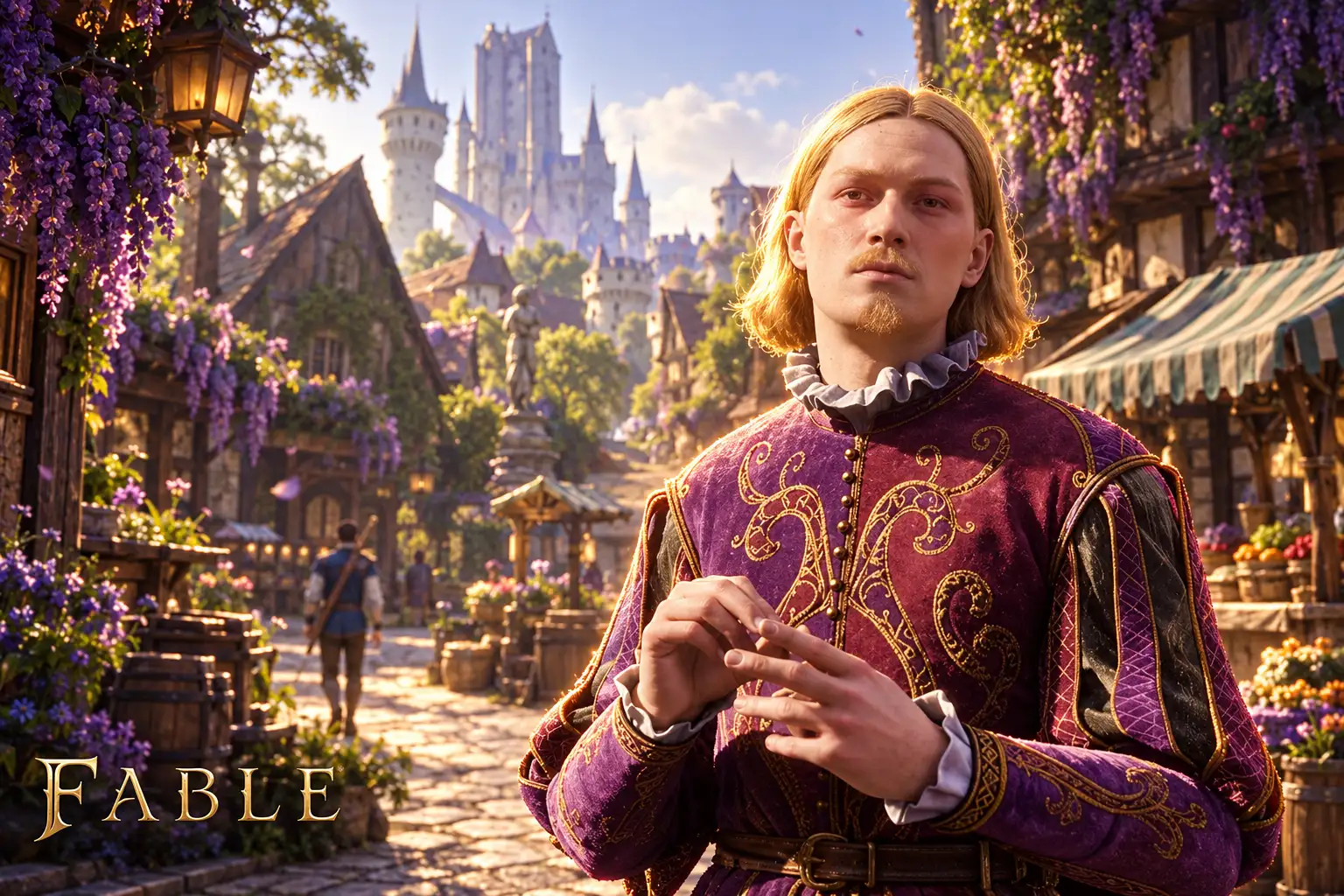
Voice Sessions Logged 1,000 Hours in 2026
Fulton told press beside Summer Game Fest that the lion’s share of the game’s talk sits in this population system. Several recording studios ran in parallel. Playground also told a group Q&A there was “no generation involved” in the voices, after being asked about text-to-speech shortcuts used elsewhere this year. The cast, Fulton said, is “a really fantastic” group of actors who came in and logged “tons and tons of dialogue.”
THE VOICE BILL
- The cast: Around 100 actors voice the Living Population alone, per Greer.
- The script: Fulton said the game holds more than 150,000 lines of dialogue.
- The sessions: Multiple studios logged more than 1,000 hours of voice recording in 2026 by June.
- The rule: Playground said those villagers are fully voiced, with no generated speech in the mix.
That bill landed on a calendar that had already moved. Xbox chief content officer Matt Booty said on May 29, 2026 that Fable was “in great shape” and that the company still wanted “a window all to its own,” shifting it out of fall 2026. The Showcase then pinned the date: February 23, 2027, with Premium early access on February 18, five days earlier.
THE REBOOT CALENDAR
- 2016: Playground Games takes on Fable, years after shipping Forza Horizon 3.
- July 2020: Microsoft announces the reboot as a new beginning for the series.
- January 2026: The Xbox Developer Direct shows gameplay and Fulton confirms a hand-built cast.
- May 29, 2026: Booty moves the game out of fall 2026 so it can have its own window.
- June 10, 2026: Greer publishes the Living Population breakdown after the Showcase.
- February 18, 2027: Premium Edition early access opens, five days before launch.
- February 23, 2027: Fable ships on Xbox Series X|S, PC, cloud, Game Pass, and PlayStation 5.
Booty’s public reason was a crowded holiday slate, not a broken NPC pipeline. The voice hours still show what the authored-cast bet consumes even when the date change is sold as scheduling.
Rivals Are Shipping Generated Companions
The other wager in 2026 is the opposite stack. NVIDIA’s June technical post on on-device AI companions for Unreal frames NPCs as local agents with speech recognition, a small language model, and text-to-speech plugins. Krafton’s PUBG Ally talks and loots as a teammate. Creative Assembly’s Total War: PHARAOH advisor, still in playtest, pulls answers from more than 1,200 linked data tables.
Those pipelines generate the line in the moment. Playground writes the line, records it, and ties it to a person who already has a job and a bed. One path scales with GPUs. The other scales with actors and designers.
AUTHORED ALBION VS GENERATED COMPANIONS
| Stack | How a character is made | How they speak | What is playable now |
|---|---|---|---|
| Fable Living Population | Each villager authored by the design team | Around 100 actors, more than 150,000 written lines | Reboot dated February 23, 2027, day one on Game Pass |
| NVIDIA ACE companions | On-device Agent, Chat, and RAG APIs | Local speech models and TTS plugins | PUBG Ally tests and a Total War advisor playtest |
Playground is not arguing that generated talk is impossible. It is arguing that a Fable villager has to be readable as one person, and that a roller, or a model, was not getting them there.
What Each Villager Is Made Of
Greer calls the result an “interactive people toybox.” On first sight the game shows a name, a role, and a Trait, the short personality tag that shapes how that person reads your reputation. Bob the Bartender, a kind-hearted commoner, is the example he uses. From there they can like you, dislike you, fear you, or fancy you.
The social panel then explains the feeling, usually from reputations in that settlement. You can hold up to six reputations in one place at once, and they collide. A chicken-chaser joke can sour one neighbor and then fade when you become a rich shop owner. Memory sits under that. Give a beggar a large sum and they remember the change in their life. Kill their spouse and they hold the grudge.
THE AUTHORED PARTS
- The Trait: A short personality line the player can see, written by design, not rolled.
- Work and home: A job, a bed, and a daily schedule, including whether they can afford the pub.
- The wardrobe: Artists pick from hundreds of modular pieces, varied by region and class.
- The voice: Fully recorded lines, not a generated stand-in, from that ~100-actor pool.
- The family: A household that can be hired, married, robbed of a spouse, or broken up.
Fulton has described those people as a Greek chorus in the street, catcalling the Hero the way the old games did, except each voice is tied to a moral worldview of its own. The uncut Fable gameplay walkthrough is where that chorus has to hold up in motion, not in a blog diagram. Modular faces are the other half of the wager, and facial animation in the Fable demo is already where that bet gets stress-tested in public.
The sharper objection around those faces is not the timesheet. It is whether a wardrobe of parts still reads as a person once you are close enough to marry them, or to fire them. That is the first real exam the hand-built cast has to pass.
Empty Towns Fill Back In on Purpose
Every adult NPC can be romanced. Greer said you can date them, marry them, have children, and live with them, “but not necessarily all at the same time.” Some will hate you for the same reputation another one fancies. Breaking a household to move in with someone changes how the rest of that house feels, and those rifts are written as recoverable if you put the work in.
Every adult NPC can also be killed. They are then gone. You can clear a settlement and watch it stay empty for a while. Associate game director Will Kennedy said the team talked through a harder rule, living with that hole forever, and rejected it because it would cut off too many systems.
You can kill every NPC in a settlement, and the settlement will stay empty for some time. But we do have a system that begins to repopulate in a settlement as well, but the reason that we do that is, we thought about it, there was a school of thought where you just live with that consequence literally forever, but we also thought in doing that it would cut off a lot of systems to players. It would be cool at first, but then it might actually get a bit annoying.
Will Kennedy, Associate Game Director, Playground Games
Fulton later said the replacements are full NPCs, with name, job, traits, home, clothing, appearance, and voice. Settlement Traits write the damage on the map. Silverbrook can become “an underpopulated farming town.” Spare or kill Dave the Giant, played by Richard Ayoade, and the same town can pick up tourists, a smell, a house-price swing, and a line like “famous for its giant corpse.”
That hedge is the tell. The toybox is allowed to break a place, then the design quietly restocks it so the rest of the game still runs. Permanence is a feeling with a timer.
Lionhead’s Street Chorus, Scaled Up
Greer is careful to say this is Playground’s Fable, not a sequel to Lionhead’s games, and then to admit the reactive crowd is one of the things that made those games Fable. The old Albion already let you flirt, gift, marry, and get shouted at in the street. Hearts grew over heads. Expressions did a lot of the courtship. The chorus was real, and it was thinner than this one.
Fulton has also cut the old halo-and-horns morph. He said there is no objective good or evil in this reboot, so a reputation has to be allowed to start at zero in a new town. Walk in with a trident on your head and that trick dies. The Living Population is doing the moral work the morph used to do, except the judges are individual worldviews, not a meter.
“You could do big things once or little things lots of times,” Fulton said, “and if people see you doing that, it contributes to you building a reputation in that particular location.” Marry several people in one settlement and someone may blackmail you. Even a basket of rotting fruit, Greer wrote, is meant to get a line. The small encounter still writes a number back into the six-tag reputation mix.
Raise Their Wages, or Don’t
The part of the bet that is not a joke about corpses is the ledger. You can buy a house and become a landlord, or buy a shop and become a boss, or do both and set wages and rent. Staff can refuse to work because they hate your reputation, and then the shop never opens. Pay them too little to make rent and they move out, which means you lose the tenant you were squeezing.
Fulton has been blunt about those levers. The Trait on a worker is not flavor text once money is involved. A hard-working villager is a production input. Stack six of them on a farm, he said, and the yield is the “smart play” if you are going the property route, a trick he credited to the level-design team.
Now, I can raise their wages, which in turn makes them happier, which would make them like me more and may make them a better employee, which then increases the overall yield of the bakery. But it might not. It might just lose me money. I could put their wages down. That’s undoubtedly going to make them dislike me, think I’m greedy, and it may decrease their performance. But it might not. See what I mean? So you’re kind of playing with a set of levers.
Ralph Fulton, Game Director, Playground Games
Kill the shopkeeper and you do not get a magical restocked counter. You get an empty shop. That is the same philosophy as the empty town, with a colder punchline: the authored person was also the economic machine, and removing them removes the machine.
Fable still has to prove all of this in play. The Premium SKU is already live as the Fable Premium Edition for $99.99, with the Chicken Suit pre-order pack and five days of early access. Xbox Series X|S, Xbox on PC, cloud, Game Pass, and Play Anywhere are the Microsoft paths; PlayStation 5 is the first time the series has sat on that hardware. The randomizer is gone. The actors are recorded. The towns can die and then fill. February 23, 2027 is when players get to pull those levers for real.

Windows 11 26H2 Turns Settings Backup On by Default

The Gears 2 PC Port Epic Refused to Ship

Ghost Recon Wildlands Returns at 4K as a Catalog Product

Waterpark Simulator Keeps the $12.99 Price After 1.0

Nurix Puts NuPlay on Microsoft Marketplace to Reach Azure Buyers

Warzone Leaves Xbox One and PS4 After Season 06

Microsoft AI Was Set Free to Build Its Own Frontier

Microsoft IQ Turns Workplace Data Into a Metered Agent Brain

Xbox Games Showcase 2026 Split the Catalog in Two

Nadella Banned Addiction Talk While Scout Kept Heartbeat
-
 NEWS5 months ago
Warzone Leaves Xbox One and PS4 After Season 06
-
 NEWS5 months ago
Microsoft AI Was Set Free to Build Its Own Frontier
-
 MICROSOFT 3655 months ago
Microsoft IQ Turns Workplace Data Into a Metered Agent Brain
-
 NEWS5 months ago
Xbox Games Showcase 2026 Split the Catalog in Two
-
 MICROSOFT 3655 months ago
Nadella Banned Addiction Talk While Scout Kept Heartbeat
-

 NEWS5 months ago
Modern Warfare 4 Splits Its Audience Before the October Launch
-

 NEWS5 months ago
Infinity Ward Bets Modern Warfare 4 on a Paid DMZ
-

 NEWS5 months ago
Dragonwilds Hits Xbox, but Steam Saves Stay Put