
AZURE
Microsoft’s Azure Playbook Does Not Map Onto Micron
Nancy Tengler maps Micron onto Azure’s old growth fade, but five-year memory contracts already cap the prices that produced Micron’s 84.9% margin.

Nancy Tengler is using Microsoft Azure’s old growth fade to argue that Micron can cool from record profits without breaking the stock. She is reading the wrong chapter.
Micron already wrote a five-year price cap at the same market levels that produced its record quarter. Azure, in the year just closed, sped up on a much larger base.
Tengler Maps Micron Onto the Wrong Azure Year
Tengler, chief investment officer at Laffer Tengler Investments, holds Micron and Microsoft. She is not treating an 84% margin, her rounding of the print, as a sell signal. She asked whether a slide toward 70% should scare anyone who sat through Azure’s first boom.
Am I concerned that margins could go down to 70%? The market will hate it, but this is what happened with Microsoft during the launch and momentum of Azure. There was a time when Azure was growing at 92%, and the stock continued to outperform for a number of years even after growth began decelerating. That’s the law of large numbers.
Nancy Tengler, chief investment officer, Laffer Tengler Investments
Her 92% figure is the Azure print from the quarter ended March 31, 2018, when Microsoft reported 93% growth, down from 98% the quarter before. The stock did keep compounding for years after that. That is a real investor memory. It is also a 2018 story about a still-small cloud line, not a 2026 story about memory sold under take-or-pay contracts.
She also undershot the paperwork. She talked about a company “signing three-year contracts and has margins of 84%.” Automotive deals at Micron generally run three years. The rest of the new book is built as five-year paper, from calendar 2026 through the end of calendar 2030.
Micron’s 84.9% Margin Came From Price
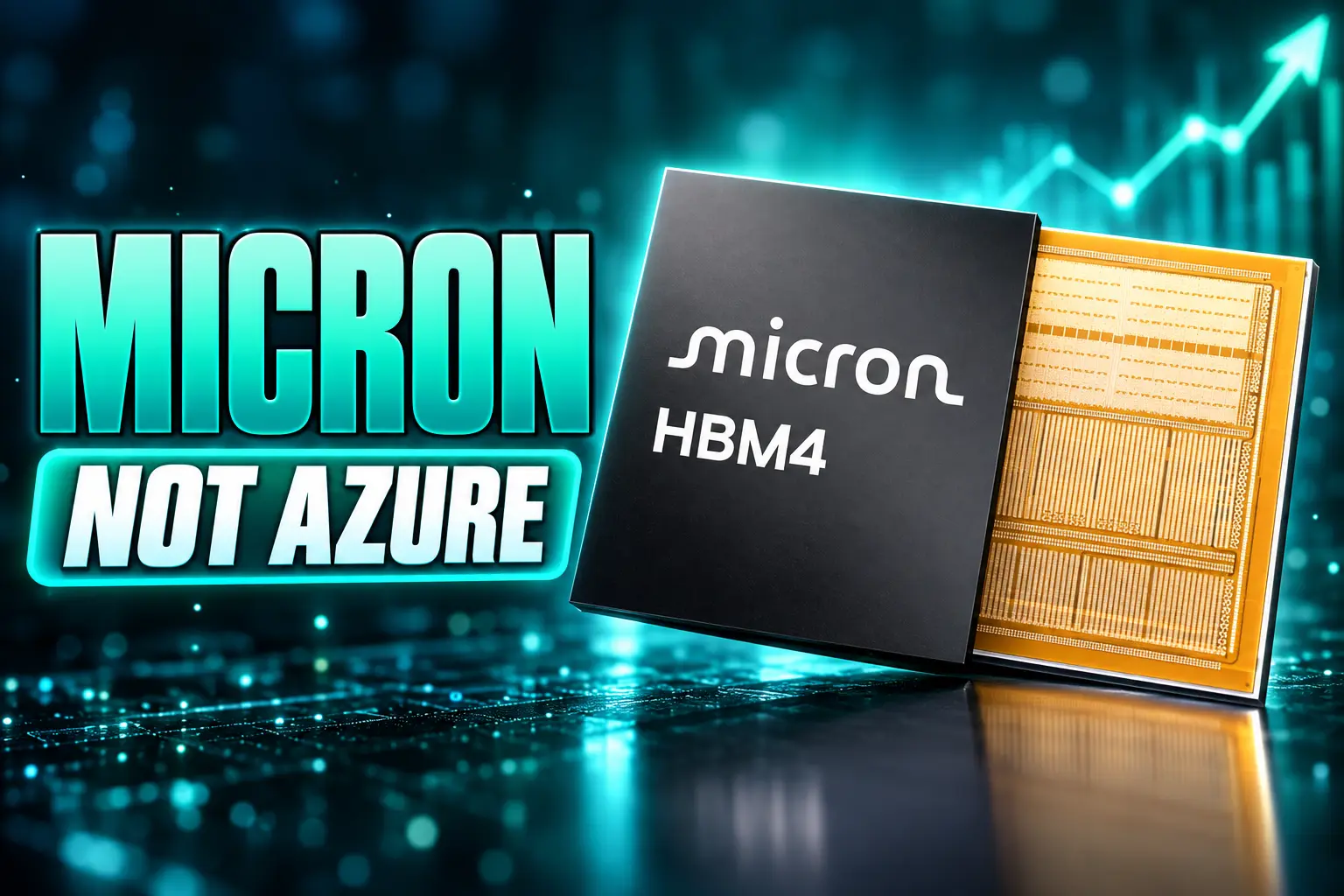
The quarter she is mapping onto Azure closed May 28, 2026, and was reported on June 24. Micron posted non-GAAP gross margin of 84.9%, up 10 points from 74.9% in the prior period and more than double the 39.0% of a year earlier. Revenue was $41.46 billion, up 74% from $23.86 billion and more than four times the $9.30 billion of the year-ago quarter. Micron put the year-on-year rise at 346%.
GAAP net income was $28.24 billion, or $24.67 a share. Non-GAAP earnings were $25.11 a share. Operating cash flow was $25.39 billion. Adjusted free cash flow was $18.3 billion after $7.1 billion of net capital spending. Cash, marketable investments, and restricted cash ended at $30.2 billion.
MICRON FISCAL THIRD QUARTER 2026
| Line | FQ3 2026 | FQ2 2026 | FQ3 2025 |
|---|---|---|---|
| Revenue | $41.46B | $23.86B | $9.30B |
| Non-GAAP gross margin | 84.9% | 74.9% | 39.0% |
| Cloud Memory revenue | $13.769B | $7.749B | $3.386B |
| Core Data Center revenue | $11.524B | $5.687B | $1.530B |
| Mobile and Client revenue | $11.521B | $7.711B | $3.255B |
| Automotive and Embedded revenue | $4.634B | $2.708B | $1.127B |
Sanjay Mehrotra, Micron’s chairman, president, and CEO, said data center revenue exceeded $25 billion, an annualized run rate over $100 billion. Cloud Memory at $13.769 billion plus Core Data Center at $11.524 billion is $25.293 billion. Data center SSD revenue exceeded $5 billion. DRAM revenue was $31.3 billion. NAND was $9.9 billion.
The gross-margin jump, Mehrotra and CFO Mark Murphy told investors, was driven primarily by higher pricing, with mix and execution helping. That is a shortage quarter. It is not an Azure-style consumption ramp in which a software platform keeps adding users while unit prices ease.
Guidance for the fiscal fourth quarter, issued the same day, called for revenue of $50.0 billion, plus or minus $1.0 billion, gross margin of about 86%, and non-GAAP earnings of $31.00 a share, plus or minus $1.00. HBM4, built on 1-beta DRAM, was already in high-volume shipments for a lead customer’s platform, with more than $1 billion of HBM4 revenue shipped and a 12-high ramp tracking twice as fast as HBM3E 12-high.
Five-Year Deals Now Cap the Record
The analog Tengler wants is a business that can slow and still pay. The analog Micron actually sold is a floor with a lid. In prepared remarks, Mehrotra said Micron had completed 16 strategic customer agreements across data center, consumer, and auto. He did not name the counterparties. Four are “very large” and three are medium-sized. The rest are smaller automotive names.
WHAT THE 16 DEALS LOCK IN
- Term: Typical run is five years, calendar 2026 through the end of calendar 2030; automotive deals generally run three years.
- Volume: About 20% of DRAM and a third of NAND over the period, structured as take-or-pay for set quantities.
- Floor and ceiling: Largest deals set a floor through the term and a ceiling for existing products at the calendar-second-quarter 2026 market price.
- Minimums: Fourteen of the 16 deals carry about $100 billion of cumulative revenue at the contract minimum; Micron projects $22 billion of cash deposits and related commitments.
- Mix when the program is done: About half or more of company revenue under these deals, with about 40% of revenue at fixed prices or ceilings at or near those calendar-second-quarter levels.
The floor, Mehrotra said, still implies gross margin “well above our peak quarterly margins in any past cycle.” That sentence is the bull case in one line. The ceiling is the sentence the Azure comparison leaves out. Buyers who signed the large deals are insulated if spot prices go higher than the levels that produced 84.9%. Micron keeps a rich floor. It also sold away some of the upside that a classic squeeze would have kept open.
The largest agreements generally have a ceiling price for existing products at the current CQ2 market price, and a floor price through the term of the agreement.
Sanjay Mehrotra, chairman, president and CEO, Micron fiscal third-quarter prepared remarks
Micron did not identify Microsoft as one of the four very large customers, and it should not be written in as if it had. Microsoft’s own Maia 200 accelerator has been described in the supply chain as an SK hynix HBM socket. Azure still fills halls with Nvidia and AMD systems, and those systems eat HBM from the three merchants, Micron included. The customer class in the deals is the same class that is building Azure-scale fleets. The names on the 16 contracts stay in the filing as a blank.
The 93% Chapter Ended in 2018
Azure did decelerate after that 93% print. Growth was 89% in the quarter ended June 30, 2018, then 76% in the quarter ended September 30, 2018. Tengler’s point about the law of large numbers is fair as history. Microsoft kept taking share for years after the rate came down, and people who sold the first down-tick in the growth rate were early.
AZURE GROWTH, THEN AND IN THE YEAR JUST CLOSED
- March 31, 2018: Azure revenue growth is 93%, down from 98% the prior quarter, the print behind Tengler’s 92% line.
- June 30, 2018: Growth is 89%.
- September 30, 2018: Growth is 76%, the slowest clip since Microsoft had been publishing the rate.
- June 30, 2026: Azure and other cloud services grow 43% in the quarter, and full-year Azure revenue surpasses $100 billion, up 41%.
That last line is why the mapping fails as a 2026 guide. Satya Nadella, Microsoft’s chairman and CEO, said on July 29 that Azure revenue surpassed $100 billion for the first time. On the same call he said Azure surpassed $100 billion, up 41%. Azure and other cloud services rose 43% in the June quarter. That is not a fade. It is a re-acceleration on a base the 2018 business did not have.
Microsoft Cloud revenue was $59.3 billion in the quarter, up 27%, and $214 billion for the fiscal year, also up 27%. Intelligent Cloud, the segment that houses Azure, was $39.3 billion, up 32%. Commercial remaining performance obligation rose 84% to $678 billion. Company revenue was $90.0 billion for the quarter, up 18%, and $331.8 billion for the year.
Gavin Baker, who runs Atreides Management, put a sharper point on the memory side of that build. On the All-In podcast he said HBM and DRAM could take 30% to 40% of hyperscaler capital spending in 2027. If that mix is even roughly right, Azure’s growth rate is no longer a clean stand-in for Micron’s margin path. Memory is becoming a larger share of the bill that produces the Azure number.
Microsoft’s Capex Is the Other Ledger
Tengler’s second Microsoft lesson is about spending. She called heavy capital spending a sign of strength when the check is written from cash flow, not from a debt binge. “You still have some of these mega-cap companies generating tens of billions of dollars in free cash flow every year, even after spending tens of billions of dollars,” she said.
Microsoft’s June quarter still fits that sentence, barely, and it shows the cost of keeping Azure growing at 43%. Amy Hood, executive vice president and chief financial officer, said capital expenditures were $41 billion in the quarter, including higher component pricing. Cash paid for property, plant, and equipment was $35.8 billion. Cash from operations was $55.4 billion. Free cash flow was $19.6 billion. Nadella said Microsoft added 31 datacenters in the quarter and 88 in the year, and that Maia 200 was scaling beside Nvidia Vera Rubin and AMD Helios racks.
MICROSOFT JUNE QUARTER CASH
- Revenue: $90.0 billion, up 18%.
- Capital expenditures: $41 billion, with $35.8 billion of cash paid for property, plant, and equipment.
- Free cash flow: $19.6 billion after $55.4 billion of operating cash flow.
- Azure: Full-year revenue over $100 billion, up 41%; quarterly Azure and other cloud services up 43%.
That is the other side of an 84.9% memory margin. Someone pays. For a Microsoft-heavy reader, the live question is not whether Micron can look through a slower growth rate the way Azure holders did after 2018. It is how much of Azure’s infrastructure bill is already memory, and how much of that bill is now on multi-year paper with a ceiling at last spring’s prices. That is also Microsoft’s rising bill for AI memory, sitting on the same ledger as the Azure growth rate Tengler wants to reuse.
What the Floor and Ceiling Buy Each Side
Mehrotra told customers the deals give them supply they can plan against while the shortage lasts. He said Micron still does not have line of sight on when supply catches demand, even if industry supply eases gradually in 2028, and he expects tightness to last beyond calendar 2027. Take-or-pay is the tool that turns that scarcity into a schedule. The customer pays for the committed volume whether it pulls every chip or not. Micron can fund fabs against that book. The $22 billion of deposits is working capital from the buyer, posted so the seller will build.
New products sit outside the cap. Micron said the deals allow later price premiums on transitions such as newer HBM generations, LP6, and DDR6, because bit cost is rising as the nodes get harder. The ceiling that matches calendar-second-quarter 2026 prices applies to existing products. That is a narrower lid than a freeze on the whole list. It is still a lid on the mix that produced the record quarter.
For Micron holders, the floor is the change from every prior cycle. In fiscal 2023 the company lost money when prices collapsed. A contract that still prints gross margin above any old peak, even at the floor, is a different equity. For Azure-scale buyers, the ceiling is the change. They are paying peak-cycle prices for years, and they are also the reason those prices cannot run away further on the volumes under the large deals.
About 80% of DRAM volume and two-thirds of NAND still sit outside the 16 deals. Spot and short contracts can still move. When the full SCA program is done, Micron wants half or more of revenue under the structure, which means a large minority of the company remains on whatever the market does next. The Azure comparison treats the whole firm as a compounder. The filing treats it as a hybrid: a contracted core with a still-cyclical sleeve.
Tengler Will Wait for a Dip
She is not chasing the stock after the run. “I think you use it as an opportunity if you’re a long-term believer. I’m not going to chase it here, but if it continues to decline, we will, in fact, step in.” That is a valuation call dressed in industrial history. It only works if the Azure years are the right history.
Azure after 2018 was a platform that kept adding workloads while the growth rate fell from a triple-digit sprint. Micron in 2026 is a memory supplier that just booked five years of peak-cycle pricing, put a ceiling on the products that made 84.9%, and guided the next quarter to about 86%. Microsoft, the company in her analogy, just printed Azure at more than $100 billion, growing 41%, and spent $41 billion of capital in a single quarter to keep that rate.
The key Microsoft holds is not a permission slip to ignore a down-tick in Micron’s margin. It is a reminder that the buyer who taught the market to look through deceleration is now paying, under contract, for the memory that makes the next turn of Azure possible.
Disclaimer: This article is news reporting and analysis for information only. It is not investment advice, a recommendation to buy or sell Micron, Microsoft, or any other security, and it is not a forecast of future prices, margins, or contract outcomes. Readers should consult a licensed financial adviser or other qualified investment professional who can consider their own objectives and risk tolerance before acting on anything here. Figures, contract terms, and outlooks reflect the company filings and comments cited, including Micron’s June 24, 2026 results and Microsoft’s July 29, 2026 results, and those items can change in later reports.

The Gears 2 PC Port Epic Refused to Ship

Ghost Recon Wildlands Returns at 4K as a Catalog Product

Waterpark Simulator Keeps the $12.99 Price After 1.0

Nurix Puts NuPlay on Microsoft Marketplace to Reach Azure Buyers

Xbox Studio Leaders Detest Game Pass for Devaluing $40 Games

Warzone Leaves Xbox One and PS4 After Season 06

Microsoft AI Was Set Free to Build Its Own Frontier

Microsoft IQ Turns Workplace Data Into a Metered Agent Brain

Xbox Games Showcase 2026 Split the Catalog in Two

Nadella Banned Addiction Talk While Scout Kept Heartbeat
-
 NEWS4 months ago
Warzone Leaves Xbox One and PS4 After Season 06
-
 NEWS3 months ago
Microsoft AI Was Set Free to Build Its Own Frontier
-
 MICROSOFT 3653 months ago
Microsoft IQ Turns Workplace Data Into a Metered Agent Brain
-
 NEWS3 months ago
Xbox Games Showcase 2026 Split the Catalog in Two
-
 MICROSOFT 3653 months ago
Nadella Banned Addiction Talk While Scout Kept Heartbeat
-

 NEWS4 months ago
Modern Warfare 4 Splits Its Audience Before the October Launch
-

 NEWS3 months ago
Infinity Ward Bets Modern Warfare 4 on a Paid DMZ
-

 NEWS3 months ago
Dragonwilds Hits Xbox, but Steam Saves Stay Put