
NEWS
Windows Got a $699 Laptop and an Unpriced Superchip
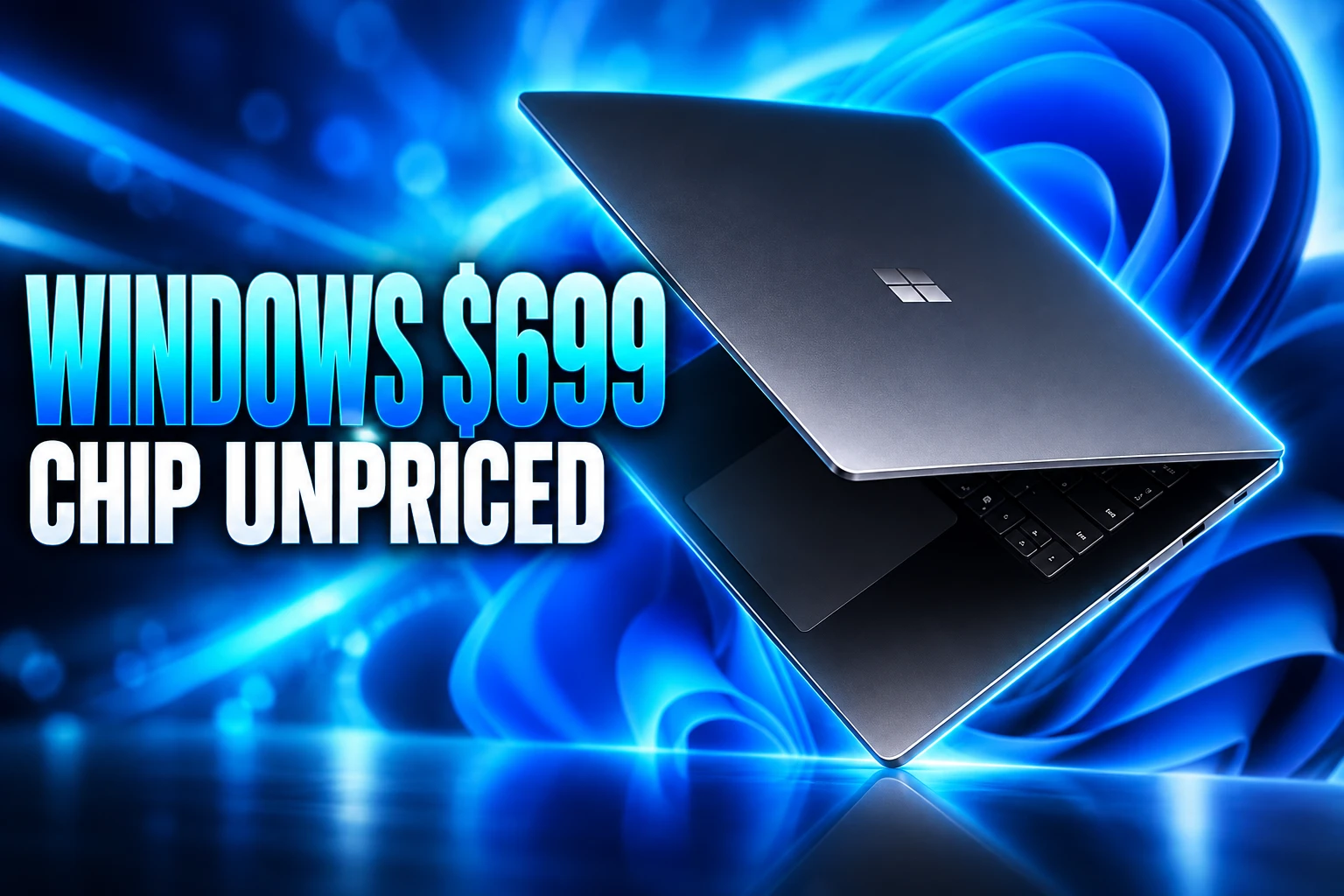
Dell’s $699 XPS 13 is on sale, Snapdragon C missed $300, and NVIDIA’s RTX Spark Windows laptops now ship in October with no public price.

NVIDIA says the first RTX Spark Windows laptops ship in October, and none of those machines has a public price. Microsoft’s June recap of Computex 2026 promised a Windows 11 PC at every price for more than a billion daily users.
Dell’s $699 XPS 13 from that list has been on sale since June 16, 2026, while the 1 petaflop Arm machines that owned the Taipei stage still lack a sticker.
Dell’s $699 XPS 13 Is Already on Desks
The one Computex price Microsoft printed for a mainstream laptop was Dell’s. Donnie Oliphant, XPS product lead at Dell Technologies, put the pitch in one line at the show, and Dell then had to live with it in stores.
With XPS 13, we’re proving that a lower price doesn’t mean accepting less. It’s the thinnest and lightest XPS we’ve ever built. This reflects where XPS is headed: more power, more innovation and stronger competition across price points.
Donnie Oliphant, XPS Product Lead, Dell Technologies
Dell’s own post says the XPS 13 starts at $699 for everyone else, and at $599 for eligible students ages 16 and up. The student deal is a back-to-school offer that runs through November 2, 2026, at 7am CST, on Core Series 3 models only, with a two-unit cap per order.
U.S. units with Intel Core Series 3 chips went on sale June 16, 2026. Core Ultra Series 3 SKUs and the Storm colorway were due later in the summer. Sky shipped first.
The chassis is 12.7mm thin and 1kg, which Dell also lists as 2.2lbs, and the company calls it the thinnest and lightest XPS laptop it has made. CNC aluminum, a 2.5K touch panel, a backlit keyboard, and Intel Wi-Fi 7 are standard. The panel runs 30Hz to 120Hz, covers 100% of DCI-P3, and Dell’s streaming test claims up to 17 hours. That run used an Intel Core 5 320, Intel Graphics, 16GB of memory, a 512GB drive, and a 150-nit screen playing Netflix at 4K.
Memory options are 8GB, 16GB, or 32GB of LPDDR5X. That 8GB floor is the detail the $699 banner does not mention, and it is the first split in Microsoft’s “every price point” line: the Windows laptop you can buy right now is an Intel thin-and-light, not an AI superchip.
Qualcomm’s $300 Pitch Meets a £499 Laptop
Qualcomm Technologies announced the Snapdragon C Platform on May 28, 2026, as the entry chip for students, families, and small shops. The press note said the platform would land in entry-tier laptops targeting $300 and up, with cool, quiet boxes and all-day battery life. Acer, HP, and Lenovo were named as partners. Acer’s Aspire Go 15 was the first machine attached to the chip.
Kedar Kondap, senior vice president and general manager of Compute and Gaming at Qualcomm Technologies, said Snapdragon C was built for “value-oriented computing, all-day battery life, AI capabilities and responsive performance in cool-quiet devices.” The silicon itself is modest: an 8-core Qualcomm Kryo CPU at 3.0 GHz, an Adreno A643 GPU at 900 MHz, and a Hexagon NPU.
The first retail listing did not match the $300 line. The Aspire Go 15 AG15-Q31P appeared in the UK at £499.99 with 8GB of LPDDR5 memory and 128GB of storage, for delivery from September 11, 2026. Acer had talked about up to 8GB and up to 512GB, plus a 15.6-inch Full HD panel and a 53Wh battery. The cheap SKU that showed up is the small drive, not the $300 floor.
Nitin Kumar, a Qualcomm vice president in product management, tied Acer’s Computex stack to both Snapdragon X2 at the top and Snapdragon C at the bottom. X2 still has a real role: Acer’s Swift Spin 14 AI and ASUS’s Ascent QN10 mini PC were quoted at up to 80 TOPS. C was supposed to be the door for people who would never buy those. At £499.99, that door is a mid-budget Arm laptop with 8GB of RAM, sitting beside Dell’s $699 Intel XPS rather than under it.
NVIDIA Moved RTX Spark to October Without a Price
The machine Microsoft put in the middle of the Taipei story was not the XPS 13. It was NVIDIA’s RTX Spark, an Arm superchip with a Grace CPU, a Blackwell RTX GPU, native CUDA, and up to 128GB of unified memory. Jensen Huang unveiled it at Computex with Microsoft, and the Windows blog said laptops would arrive beginning in the fall from Surface, ASUS, Dell, HP, Lenovo, and MSI, with compact desktops from Acer, ASUS, Dell, Gigabyte, HP, Lenovo, and MSI.
At IFA in early September, NVIDIA tightened that window to October 2026. Partner posts still say “this fall.” HP said so on September 3, 2026, while pushing the OmniBook Ultra 16.
https://x.com/HP/status/2095554011873079393
No OEM has posted a consumer price. Channel chatter after Computex put high-end N1X boxes around $2,899 and lesser N1-class machines near $1,799, in a Morgan Stanley note drawn from brand checks. Those are estimates, and memory costs can push street prices the other way. The working fact is simpler: you still cannot add a Spark laptop to a cart.
THE FALL CALENDAR
- May 28, 2026: Qualcomm announces Snapdragon C for $300-and-up laptops.
- June 1, 2026: NVIDIA unveils RTX Spark at Computex with Microsoft and the first named laptops.
- June 10, 2026: Mark Linton, vice president of Windows + Devices, publishes the partner recap.
- June 16, 2026: Dell puts the Core Series 3 XPS 13 on sale in the U.S.
- June 23, 2026: MSI’s Claw 8 EX AI+ goes on sale.
- September 3, 2026: NVIDIA points Spark systems at October; HP repeats the fall window.
- October 2026: first RTX Spark laptops and small desktops are due.
The wait on X is now that October date, and the missing number is still the sticker. People who want a 128GB deskside box are already asking brands for specific SKUs. The unproven part is whether Arm Windows can run local models and current games on the same machine without feeling like two half products glued together.
What the N1X Chip Puts in Those Machines
RTX Spark is NVIDIA’s name for a family it now labels N1X. The product page rates the full chip at up to 1 petaflop of FP4 performance, a 20-core Grace CPU, a 6,144-core Blackwell RTX GPU, and up to 128GB of unified LPDDR5X. CUDA runs natively. Microsoft says the design was done with MediaTek and Microsoft, and that Windows will carry NVIDIA’s OpenShell runtime, built on MXC, so always-on agents can be packaged for developers.
That Arm leap is Windows third shot at Arm laptops, this time with NVIDIA’s software stack instead of a Qualcomm-only premium tier. Prism still has to emulate x86 apps. The GPU side is the pitch that previous Arm Windows boxes could not make: DLSS 5, Reflex 2, fourth-generation ray tracing cores, fifth-generation Tensor cores, and the same Studio and Game Ready driver brands NVIDIA already sells on x86.
RTX SPARK N1X SKUS
| Part | Full N1X | Cut-down N1X |
|---|---|---|
| GPU | 6,144-core Blackwell RTX | 5,120-core Blackwell RTX |
| CPU | 20-core Grace | 18-core Grace |
| Memory | Up to 128GB LPDDR5X | Up to 64GB LPDDR5X |
| Laptop power | 45-80W | 45-80W |
| Desktop power | 140W (full chip) | Laptop only |
| OS | Windows 11 | Windows 11 |
Microsoft’s Surface Laptop Ultra is the house flagship on the full chip. Brett Ostrum, corporate vice president of Surface, is selling it as the most powerful Surface Laptop the company has built: a 15-inch mini-LED PixelSense Ultra touchscreen, all-day battery claims, creator ports, up to 128GB of unified memory, and local runs of up to 120B-parameter models with a 1 million token context. That last pair is NVIDIA’s figure, based on theoretical FP4 TOPS with sparsity. Microsoft has not named a price or a day, only later in 2026.
FIRST-WAVE SPARK BRANDS
- Laptops named in June: Surface Laptop Ultra, ASUS ProArt P16 and P14, Dell XPS 16 Creator Edition, HP OmniBook Ultra 16 and OmniBook X 14, Lenovo Yoga Pro 9n, MSI Prestige N16 Flip AI+.
- Desktops named in June: compact PCs from Acer, ASUS, Dell, Gigabyte, HP, Lenovo, and MSI, plus a Surface RTX Spark Dev Box.
- IFA add-ons: Lenovo’s Yoga 9n 2-in-1 and an Acer small-form-factor Spark desktop, still without prices.
- Enterprise sidecar: NVIDIA DGX Station for Windows, on a GB300 Grace Blackwell Ultra superchip, billed for local models up to 1 trillion parameters.
Those names are six PC makers behind the Spark bet in the first laptop wave, with Acer and Gigabyte told to follow. MSI’s Prestige N16 Flip AI+ is the odd one in the pile, a 16-inch UHD+ tandem OLED 2-in-1 that NVIDIA helped shape from scratch. HP still has not priced the OmniBook pair. ASUS was the brand willing to read full spec sheets in June, including a 16-inch ProArt P16 with a 99.9Wh battery in early briefings.
Intel’s Handheld Chips Reached Stores First
Intel did not win the Taipei laptop keynote. It did ship silicon. Arc G3 and Arc G3 Extreme are Arc G-series handheld processors, launched in Q2 2026, each with 14 cores and 12MB of cache. Extreme tops out at 4.7 GHz. They are Core Ultra Series 3 parts with the core count trimmed and the Xe3 GPU left wide, built for an 8-inch shell rather than a 16-inch creator deck.
Intel’s own geomean, measured in May 2026 on a pre-production MSI Claw 8 EX AI+ across 36 titles at 1080p High and 35W, says Arc G3 Extreme is 44% faster than the Intel Core Ultra 7 258V in the prior Claw 8 AI+. The same page claims as much as 11 hours of gameplay with Endurance Gaming, and more than 3x faster average loads with precompiled shaders. Dan Rogers, vice president and general manager of PC Product in Intel’s Client Computing Group, used Computex to draw a hard line against tradeoffs.
Intel Arc G-Series represents years of focused innovation and a deep commitment to gaming. It delivers uncompromising PC performance in the palm of your hand, combined with the console-like accessibility and immediacy gamers expect. With cutting-edge graphics technologies like XeSS 3 and breakthrough efficiency for longer unplugged play, Intel Arc G-Series proves that while others make tradeoffs, gamers don’t have to.
Dan Rogers, Vice President and General Manager, PC Product, Client Computing Group, Intel
ARC G3 HANDHELDS FROM COMPUTEX
| Device | Chip | Status | Price |
|---|---|---|---|
| MSI Claw 8 EX AI+ | Arc G3 Extreme | On sale June 23, 2026 | $1,799.99 (32GB, 1TB, MSI store) |
| Acer Predator Atlas 8 | Arc G3 or G3 Extreme | Due October 2026 | From £999 in the UK (16GB, 512GB, G3) |
| OneXPlayer 3 | Arc G-Series | Announced for June | Not listed here |
The Claw 8 EX AI+ is the unit you can hold. It uses an 8-inch 1920×1200 panel with 48-120Hz VRR, an 80Wh battery, dual Thunderbolt 4, Wi-Fi 7, and a Void Purple shell. That $1,799.99 tag is the other half of Rogers’s “no tradeoffs” line. Intel’s graphics lead showed up in reviews. The bill matches a high-end laptop, not a pocket console.
Acer’s cheaper G3 Atlas 8 is the volume test, if the £999 UK floor holds when October orders open. Intel still has a loud x86 gaming laptop in the same Computex pile: ASUS’s ROG Strix SCAR 18, at up to 320W, with an Intel Core Ultra 9 290HX Plus, an NVIDIA GeForce RTX 5090 Laptop GPU, and an 18-inch 4K 240Hz mini-LED panel. Spark is not replacing that class this year. It is arriving beside it, on a different instruction set, at a price nobody will print.
Windows Now Sells Three Different Computers
Mark Linton wrote that partners were shaping the PC for more than a billion daily users, and that there is a Windows device for every person and purpose no matter what price point. Score that sentence against a cart, and it breaks into three checkouts that barely share a chip.
WHAT SHIPPED AND WHAT DID NOT
| Machine | Silicon | Price | Buy it? |
|---|---|---|---|
| Dell XPS 13 | Intel Core Series 3 | $699 ($599 student) | On sale since June 16, 2026 |
| Acer Aspire Go 15 | Snapdragon C | £499.99 in the UK | Listed for delivery from September 11, 2026 |
| MSI Claw 8 EX AI+ | Intel Arc G3 Extreme | $1,799.99 | On sale since June 23, 2026 |
| RTX Spark laptops | NVIDIA N1X | Unlisted | NVIDIA says October 2026 |
| Surface Laptop Ultra | NVIDIA RTX Spark | Unlisted | Microsoft: later in 2026 |
The second-order result of Taipei is not “more Windows SKUs.” It is a platform that now asks OEMs to stock Intel for the $699 floor and for handhelds, Qualcomm for a second Arm budget path that missed $300, and NVIDIA’s MediaTek-tuned Grace-Blackwell package for a CUDA laptop that still has no MSRP. Those three lanes need different drivers, different emulators, and different sales stories. They share a Start menu.
Dell kept the only price Microsoft bothered to repeat. Qualcomm kept the keynote line and lost it on the first Amazon card. NVIDIA kept the stage, then moved the boxes into October and left the buy button as an email form. The $599 student offer on the XPS 13 runs through November 2, 2026. NVIDIA’s RTX Spark page still asks for an address instead of an order.

The Gears 2 PC Port Epic Refused to Ship

Ghost Recon Wildlands Returns at 4K as a Catalog Product

Waterpark Simulator Keeps the $12.99 Price After 1.0

Nurix Puts NuPlay on Microsoft Marketplace to Reach Azure Buyers

Xbox Studio Leaders Detest Game Pass for Devaluing $40 Games

Warzone Leaves Xbox One and PS4 After Season 06

Microsoft AI Was Set Free to Build Its Own Frontier

Microsoft IQ Turns Workplace Data Into a Metered Agent Brain

Xbox Games Showcase 2026 Split the Catalog in Two

Nadella Banned Addiction Talk While Scout Kept Heartbeat
-
 NEWS4 months ago
Warzone Leaves Xbox One and PS4 After Season 06
-
 NEWS4 months ago
Microsoft AI Was Set Free to Build Its Own Frontier
-
 MICROSOFT 3654 months ago
Microsoft IQ Turns Workplace Data Into a Metered Agent Brain
-
 NEWS4 months ago
Xbox Games Showcase 2026 Split the Catalog in Two
-
 MICROSOFT 3654 months ago
Nadella Banned Addiction Talk While Scout Kept Heartbeat
-

 NEWS4 months ago
Modern Warfare 4 Splits Its Audience Before the October Launch
-

 NEWS4 months ago
Infinity Ward Bets Modern Warfare 4 on a Paid DMZ
-

 NEWS4 months ago
Dragonwilds Hits Xbox, but Steam Saves Stay Put