
NEWS
Brother INKvestment Printers Carry a Small-Office Spec Sheet
Brother’s new INKvestment all-in-ones start at $279.99, but the 31-pound chassis, LC506 cartridges, and fax hardware are built for a small office.

Brother International priced two new INKvestment all-in-ones at $279.99 and $359.99 on July 7, 2026. The MFC-J5010DW and MFC-J5110DW print, scan, copy, and fax, and each box includes LC506 ink rated at 1,800 black pages and 750 pages per color under ISO/IEC 24711.
The launch copy talks about cramped home desks. The hardware is a 17.1-inch-wide office inkjet that still takes sealed cartridges, still sends faxes, and still offers Brother Refresh in the setup flow.
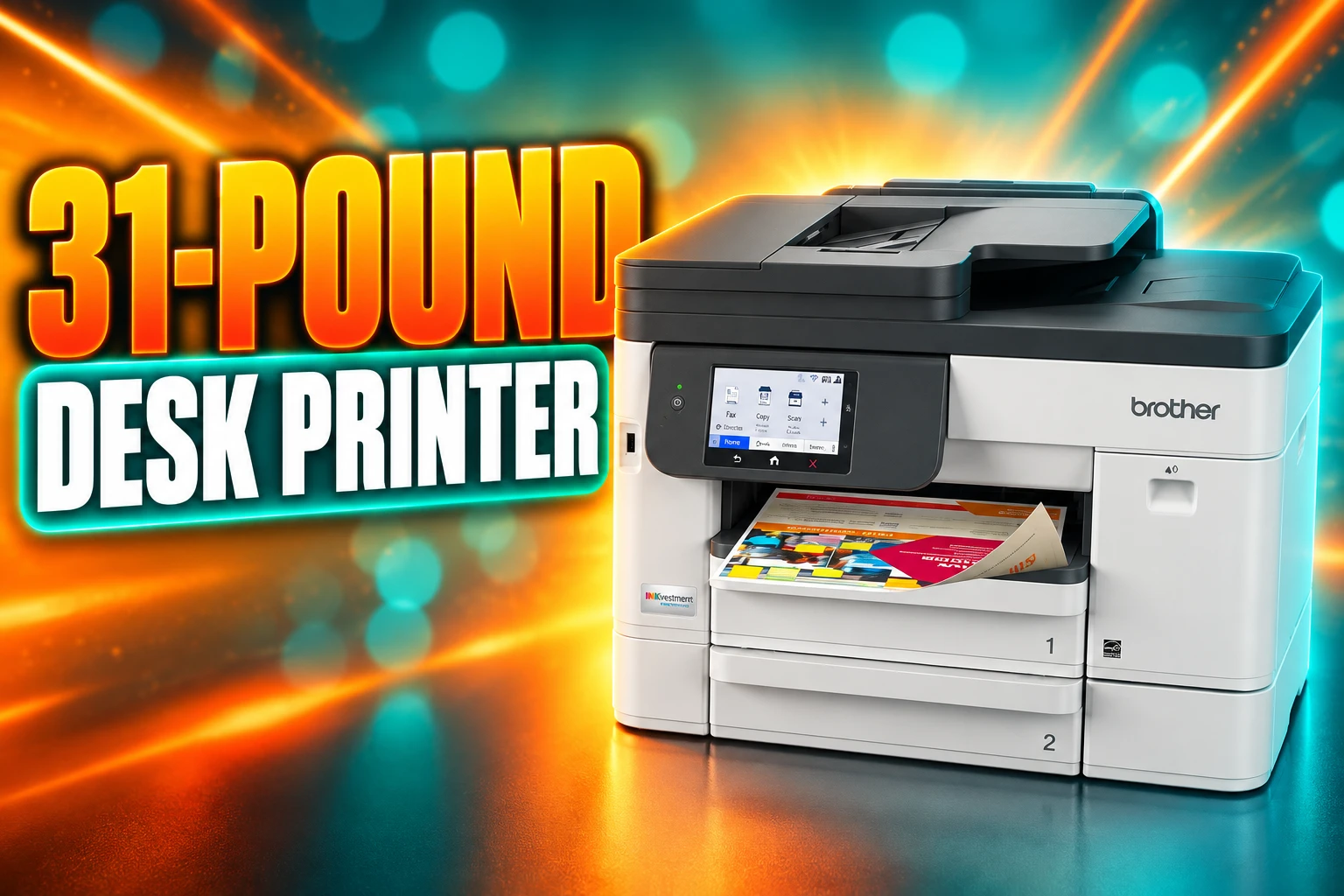
A 31-Pound Printer Sold as a Desk Saver
Eric Dahl, vice president of product marketing for Brother International’s Business Machine Group, framed the gap the company wanted to fill. He said small-business printers should not force a choice among capability, price, and space.
We saw a clear opportunity in the market for small business printers that do not force you to choose between capability, affordability and space efficiency. The new INKvestment series delivers all three, along with the reliability and support that Brother is known for.
Eric Dahl, vice president of product marketing, Brother International Corporation
Space efficiency is the claim that does not survive a tape measure and a bathroom scale. The cheaper chassis is 17.1 inches wide, 17.3 inches deep, and 10.7 inches tall. Brother’s published hardware specifications put that machine at 30.9 lb. The $360 model is the same width, 13.4 inches tall, and 37.7 lb. Open the cassettes and the 5110 grows to 27.2 inches deep.
THE COMPACT CLAIM ON THE SCALE
- The 5010: 17.1 by 17.3 by 10.7 inches, 30.9 lb, one 250-sheet tray plus a one-sheet manual slot.
- The 5110: 17.1 by 17.3 by 13.4 inches, 37.7 lb, two 250-sheet trays plus a 100-sheet multipurpose tray.
- Shared engine: Piezo heads with 420 nozzles per color, 512 MB of memory, and about 53.5 dB while printing.
- Shared speed: Up to 28 ppm black and 26 ppm color, measured after the first ISO/IEC 24734 test set.
A letter-size printer has to be about 17 inches wide or it cannot feed 8.5-inch paper, so the width is honest. The weight is the tell. Thirty-one pounds is a two-handed lift off a warehouse pallet, not a laptop-bag accessory you slide beside a monitor.
59.99
What Separates the $280 Model From the $360 One
Both machines share MAXIDRIVE piezo heads, PerfectPrint Auto Detection, automatic two-sided printing, a 50-page single-pass duplex ADF, Wi-Fi, Wi-Fi Direct, gigabit Ethernet, USB, and the Brother Mobile Connect app. Cloud print and scan paths include Google Drive, Dropbox, Box, and OneDrive. First-page times in retailer listings are 4.5 seconds in black and 4.7 seconds in color from ready.
The extra $80 on the 5110 buys paper handling and a larger panel, not a faster engine. The INKvestment 5010 wireless all-in-one is the solo-shop SKU: one 250-sheet cassette, a one-sheet bypass, and a 2.7-inch touchscreen. The 5110 splits 500 sheets across two cassettes, adds the 100-sheet multipurpose tray for envelopes and labels, and moves to a 4.3-inch screen. Total input on the 5110 is 600 sheets if you load the multipurpose tray too.
THE TWO US MODELS SIDE BY SIDE
| Spec | MFC-J5010DW | MFC-J5110DW |
|---|---|---|
| List price | $279.99 | $359.99 |
| Paper input | 250 + 1-sheet slot | 500 in two trays + 100 MP |
| Touchscreen | 2.7 in. | 4.3 in. |
| Weight | 30.9 lb | 37.7 lb |
| Print languages | Brother Raster | PCL6, BR-Script3, PDF 2.0 |
| Fax modem | 14,400 bps Group 3 | 33,600 bps Super Group 3 |
| USB walk-up PDF | JPEG only | JPEG and PDF 2.0 |
Amazon listings already carried those list prices on June 1, 2026, more than a month before the Bridgewater, N.J., announcement. Brother said the pair is sold through authorized retailers and brother-usa.com. A third sibling, the MFC-J5115DW, sits on the same North American spec sheet at 38.6 lb with NFC; it was not in the July 7 U.S. price list.
LC506 Cartridges Outlast the Starter Pack
Brother is explicit that these printers take genuine LC506 ink, “the only brand we recommend.” The in-box set is the marketing hook: 1,800 black pages and 750 pages each for cyan, magenta, and yellow. That black starter is richer than the 1,000-page LC506 standard replacement. The color starters are not. A standard LC506 yellow cartridge is rated at 900 pages, so the “high-yield in the box” color fill sits 150 pages under the cheapest replacement you can buy later.
Replacement math is where the INKvestment name has to earn its keep. Office listings price a standard LC506 black cartridge at $34.64, which is 3.46 cents a page at the 1,000-page rating. The LC506XXL black Super High Yield cartridge is $87.66 and 5,000 pages, which is 1.75 cents a page. Brother’s own site lists a high-yield LC506XL four-pack at $165.49 for 2,500 black pages and 1,500 pages per color. An LC506XXL cyan cartridge is $56.29 for 2,500 pages, about 2.25 cents on that one color.
LC506 YIELDS AND STREET PRICES
| Cartridge | ISO yield | Listed price |
|---|---|---|
| In-box black | 1,800 pages | Included |
| In-box C/M/Y (each) | 750 pages | Included |
| LC506 black standard | 1,000 pages | $34.64 |
| LC506 yellow standard | 900 pages | Sold separately |
| LC506XL black / color | 2,500 / 1,500 pages | $165.49 as a 4-pack |
| LC506XXL black | 5,000 pages | $87.66 |
| LC506XXL cyan | 2,500 pages | $56.29 |
Those cents-per-page figures beat classic small inkjet cartridges and lose to bottle tanks. Brother’s Australian running-cost note on INKvestment versus bottle-tank running costs puts a tankbenefit bottle printer at about $0.003 a page, against roughly $0.02 black and $0.03 color on a high-yield INKvestment cartridge printer in that market. U.S. EcoTank bottles in 2026 price indexes cluster near $0.006 a page. The 5010 and 5110 are not chasing that floor. They are chasing fewer swaps without asking anyone to pour a bottle.
Fax and Ethernet Are Still on the Spec Sheet
If these were only home snapshot printers, the fax block would have been the first thing to cut. It was not. The 5010 speaks ITU-T Group 3 at 14,400 bps. The 5110 steps up to Super Group 3 at 33,600 bps. Both keep a 100-name address book with two numbers or email addresses per name, broadcast to 250 destinations, and hold up to 150 pages in memory for send or out-of-paper receive.
The rest of the I/O is the same tell. Gigabit Ethernet sits next to dual-band 802.11a/b/g/n and a USB 2.0 Type A/B port. The 5110 speaks PCL6, BR-Script3, and PDF 2.0, which is how a shared Windows queue in a five-desk office actually talks to a printer. The 5010 stays on Brother Raster. U.S. office listings attach a 2-year limited warranty.
THE OFFICE FEATURES THAT SURVIVED THE HOME SKU
- Paper up to legal: Trays and the ADF take 8.5 by 14 inch stock, with automatic duplex on plain and recycled sheets.
- Single-pass duplex ADF: 50 pages, both sides in one pass, on both models.
- Wired networking: 10/100/1000 Ethernet plus IPsec, 802.1X, and SNMPv3 on the spec sheet.
- Walk-up media: USB flash printing in JPEG on both; PDF 2.0 walk-up on the 5110 and 5115.
Copying runs at about 33 W, ready power is 4.5 W on the 5010 and 5.0 W on the 5110, and sleep is about 0.9 W. Even at power off, the machine wakes itself for head maintenance, which is the inkjet tax you pay for leaving pigment sitting in 1,680 nozzles.
INKvestment Feeds a Tank You Never Fill
The name does the confusing work. INKvestment Tank, launched in the United States in 2018 on the MFC-J995DW at $199, is not a bottle system. High-yield cartridges dump into an internal reservoir inside the printer. You still snap in a sealed cart. You never funnel a bottle. Page Gauge estimates remaining pages on the panel and in Mobile Connect.
Retail listings still flag the 5010 and 5110 as SuperTank / INKvestment Tank machines even though the July PR dropped “Tank” from the headline. The mechanics match the 2018 design: LC506 cartridges, an internal store, and no user-filled tanks. That is cleaner than EcoTank. It is also why the running cost cannot fall to bottle money. You are still buying Brother’s cartridge, chip and all.
HOW INKVESTMENT GOT HERE
- July 18, 2018: Brother International introduces INKvestment Tank on the MFC-J995DW at $199, with an internal reservoir and a claim of up to one year of ink in the box at about 150 pages a month.
- June 1, 2026: Amazon listings appear for the MFC-J5010DW and MFC-J5110DW at $279.99 and $359.99, already naming LC506 ink.
- July 7, 2026: Brother International announces the pair from Bridgewater, N.J., plugging MAXIDRIVE, PerfectPrint, and Refresh in the same release. Parent Brother Industries reports global annual sales exceeding $6 billion.
Owners of older INKvestment Tank units at light home volume describe in-box ink lasting years, which is the system working as designed when you print a few hundred pages a month. The new machines are faster (28 ppm versus the 20 ppm class of the J4535 generation) and hold more paper. They do not change the basic deal: pay cartridge prices to avoid a funnel.
Bottle-tank printers still win on cost per page if you print a lot and will handle refills. Brother lasers still win if the job is black text and you want third-party toner. These inkjets sit in the remaining slice, offices that want color, sealed carts, and an Ethernet port, and will not sign a page-allotment contract to get them.
Brother Still Offers a Two-Month Refresh Trial
The same launch that sells high in-box yields also sells a subscription. The July 7 release tells buyers they can pick a Refresh plan based on monthly usage and get replacement cartridges before they run out, with the option to change or cancel. Brother’s own subscription terms cap INKvestment Tank models at a 2-month free trial. Other Refresh-ready printers can see a longer teaser. Overages and taxes still apply during the trial, and unused pages roll over under the plan rules.
That is the awkward seam next to Brother’s bet against ink subscriptions. You can run LC506 carts a la carte at 1.75 cents a black page on the XXL. You can also enroll at setup and let Brother meter pages. The hardware does not force the plan the way some HP+ models do. The setup path still puts the plan in front of you, and the in-box cartridges are Refresh-ready on eligible units.
If you skip Refresh, you are back on genuine LC506 or a compatible, with the usual chip warnings on the panel. Brother’s support flow for “Replace Ink” after a swap still pushes genuine INKvestment Tank cartridges and treats missing logos or missing green chips as a reason the gauge may not clear.
The Buyer These Machines Were Built For
Dahl’s quote named growing businesses, not a studio apartment. The 5110’s dual cassettes, 100-sheet bypass, PCL stack, and Super Group 3 fax are the feature set of a front desk that still prints packing slips and scans IDs. The 5010 is the same print engine with one tray for a solo shop that wants the 50-page duplex ADF and does not want to lift 38 pounds onto a bookshelf.
WHO THE SPEC SHEET ACTUALLY FITS
- A small office that still faxes: Both models keep Group 3 hardware; the 5110 is the faster modem and the better shared queue.
- A shop that will not pour bottles: LC506 snaps in, feeds the internal tank, and skips the funnel and the wipe-down.
- A desk that can take the weight: 30.9 lb or 37.7 lb, 17.1 inches of width, and up to 600 sheets of paper in the taller chassis.
A student or a household printing 50 pages a month will still spend less, over a couple of years, on a bottle tank whose in-box ink is measured in the thousands. A shop that already resents HP-style lock-in, needs legal paper and duplex scan, and wants the cartridge motion it already knows is the buyer this chassis was tooled for. The printers list at $279.99 and $359.99 through Brother authorized retailers, the same prices Amazon posted in early June.
Frequently Asked Questions
What ink do the Brother MFC-J5010DW and MFC-J5110DW use?
They use the Brother LC506 family, with standard, XL, and XXL yields. Standard black is 1,000 pages, XL black is 2,500, XXL black is 5,000, XL color is 1,500, and XXL color is 2,500, all under ISO/IEC 24711 on letter or A4. The in-box set is a one-off 1,800-page black fill and 750-page color fills, which do not match any of those replacement SKUs exactly.
Do the new INKvestment printers work with Windows 11?
Brother’s spec sheet lists TWAIN and WIA drivers for Windows 10 and Windows 11, plus AirPrint, Mopria, Wi-Fi Direct, and Brother Mobile Connect for phones. Optical scan resolution is up to 1200 by 2400 dpi from the glass and 600 by 600 dpi from the ADF, with interpolated scanning up to 19200 by 19200 dpi through TWAIN.
What is the Brother MFC-J5115DW?
It is a third machine on the same user-guide spec sheet as the 5010 and 5110, drawing 100 to 120 V, weighing 38.6 lb, and adding NFC. It shares the 5110’s 4.3-inch screen, PCL6 / BR-Script3 / PDF 2.0 languages, and Super Group 3 fax. Brother’s July 7 U.S. launch priced only the 5010 and 5110.
Can these printers make borderless prints?
Yes. The printer block lists borderless output on letter, A4, legal, folio, A6, 4-by-6, 3.5-by-5, 5-by-7, and 5-by-8 index card stock, with a borderless width of 8.50 inches. Glossy pages have to come out of the 150-sheet face-up output tray right away or they smudge. Long paper on the 5110’s multipurpose tray can run up to 47.2 inches, one sheet at a time.
How much power do the MFC-J5010DW and MFC-J5110DW use?
Copying is about 33 W on both. Ready is about 4.5 W on the 5010 and 5.0 W on the 5110. Sleep is about 0.9 W, and power off is about 0.02 W, measured on the ENERGY STAR 3.2 method. The off figure is not a hard zero, because the printer powers itself back on for print-head maintenance, then shuts down again.
Do both models still include a fax modem?
Yes. The 5010 is ITU-T Group 3 with a 14,400 bps fallback modem. The 5110 and 5115 are Super Group 3 at 33,600 bps. Both store up to 150 pages for memory transmission or out-of-paper receive, redial once after five minutes, and support automatic two-sided sending from the ADF. Copy jobs can stack or sort up to 999 pages and scale from 25 percent to 400 percent.

The Gears 2 PC Port Epic Refused to Ship

Ghost Recon Wildlands Returns at 4K as a Catalog Product

Waterpark Simulator Keeps the $12.99 Price After 1.0

Nurix Puts NuPlay on Microsoft Marketplace to Reach Azure Buyers

Xbox Studio Leaders Detest Game Pass for Devaluing $40 Games

Warzone Leaves Xbox One and PS4 After Season 06

Microsoft AI Was Set Free to Build Its Own Frontier

Microsoft IQ Turns Workplace Data Into a Metered Agent Brain

Xbox Games Showcase 2026 Split the Catalog in Two

Nadella Banned Addiction Talk While Scout Kept Heartbeat
-
 NEWS4 months ago
Warzone Leaves Xbox One and PS4 After Season 06
-
 NEWS4 months ago
Microsoft AI Was Set Free to Build Its Own Frontier
-
 MICROSOFT 3654 months ago
Microsoft IQ Turns Workplace Data Into a Metered Agent Brain
-
 NEWS4 months ago
Xbox Games Showcase 2026 Split the Catalog in Two
-
 MICROSOFT 3654 months ago
Nadella Banned Addiction Talk While Scout Kept Heartbeat
-

 NEWS4 months ago
Modern Warfare 4 Splits Its Audience Before the October Launch
-

 NEWS4 months ago
Infinity Ward Bets Modern Warfare 4 on a Paid DMZ
-

 NEWS4 months ago
Dragonwilds Hits Xbox, but Steam Saves Stay Put