
NEWS
The $145 ASUS Chromebook CM30 Splits a Single USB-C Port
The ASUS Chromebook CM30 sold as a $144.97 laptop-tablet hybrid is a Grade A leftover with one USB-C port and ChromeOS updates through June 2033.

Deal sites sold the ASUS Chromebook CM30 as a $144.97 laptop and tablet in one. The July 12 promotion ran through July 19 on a Grade A refurbished 8GB unit.
A U.S. retailer later listed a new Fog Silver twin at $449.99, on backorder until November 2026. Both modes still share a single USB-C port.
The $145 Deal Was a Grade A Leftover
The $144.97 offer was not a new machine at a secret ASUS price. It was a Grade A refurbished CM3001, the same 2024 detachable ASUS still shows in Fog Silver, sold with a 90-day parts and labor warranty from a third party.
Grade A, in the listing copy, meant near-mint hardware with minimal to zero scuffing on the case. The sticker next to that price was $369.99, a $225.02 gap that made the slate look like a fire sale rather than leftover education stock.
THE JULY RESTOCK
- Deal price: $144.97 for the 8GB, 128GB Grade A unit through July 19, 2026.
- Later listing: StackSocial put the same Grade A model at $149.99 on a July 28, 2026 page and marked it sold out.
- Warranty: 90 days of aftermarket parts and labor, not ASUS’s full retail cover.
- Condition grade: Near-mint cosmetic standard, with the keyboard cover, adapter, and USI 2.0 stylus in the box.
The chassis is the piece the deal copy kept underselling. ASUS builds the CM30 to US MIL-STD 810H, puts a Titan C security chip on the board, and uses 30% PIR recycled aluminum. Germany’s iF jury gave the detachable an iF Design Award 2024 on March 8, 2024, months before U.S. deal sites started cycling Grade A units through sub-$150 carts.
Energy use is rated up to 44% below ENERGY STAR’s bar, and the model carries EPEAT Gold. That is school-fleet language. It is also why a $144.97 refurb can look this finished when a typical $150 Windows clamshell does not.
Two Gadgets Share One USB-C Port
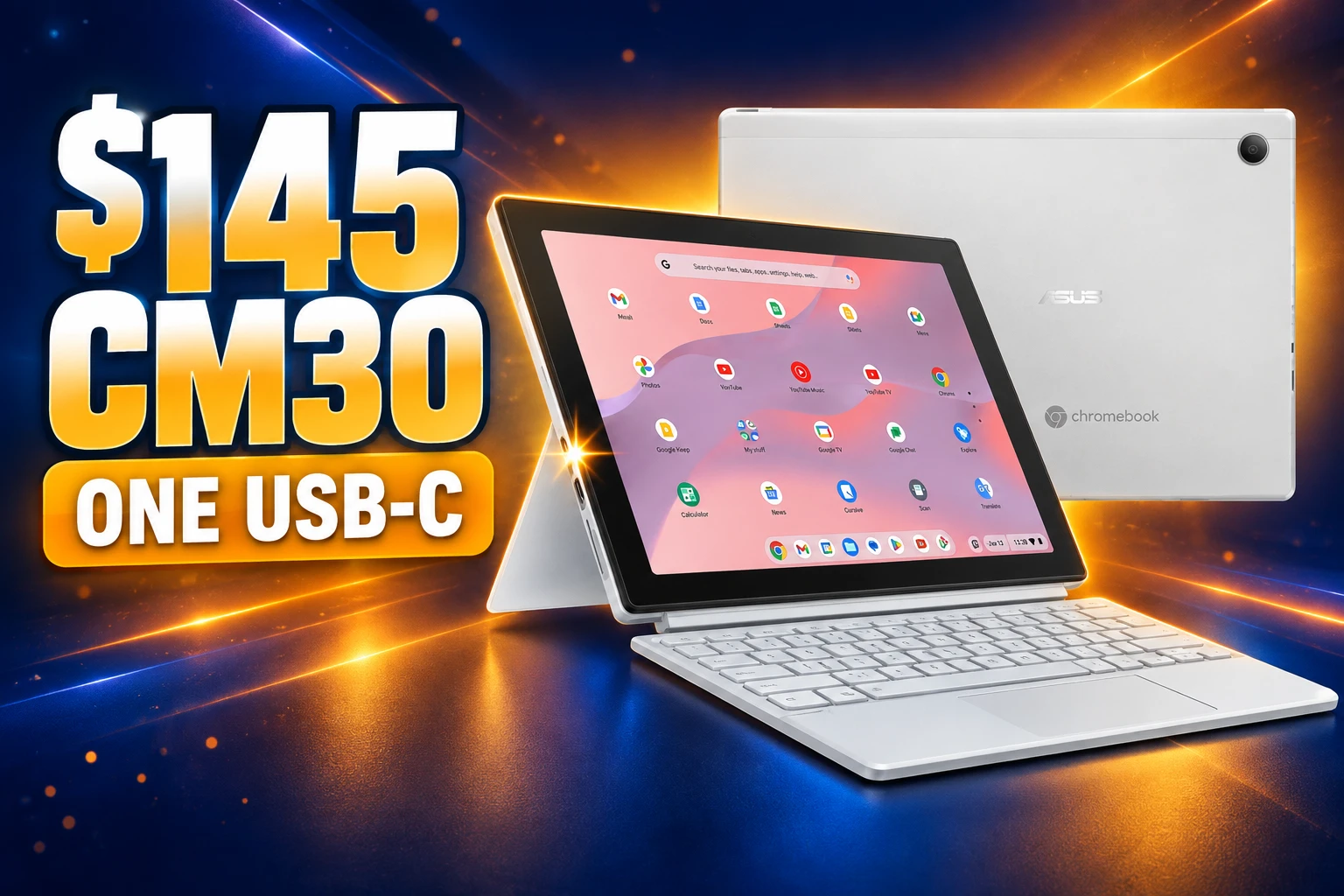
ASUS’s own spec sheet is blunter than the deal posts. Laptop mode and tablet mode are the same 10.5-inch panel, the same MediaTek Kompanio 520, and one USB 3.0 Type-C port that handles charging, data, and DisplayPort. Plug in the 45W adapter and the only data jack is gone. There is no USB-A and no HDMI.
The tablet starts at 0.61 kg (1.34 lbs). With the magnetic stand and keyboard clipped on, ASUS says the package stays under a kilo. The screen is a glossy 1920 x 1200 16:10 panel at 400 nits and 118% sRGB, which is bright enough for a classroom and small for a full workday of docs.
WHAT BOTH MODES SHARE
| Job | Hardware | Limit |
|---|---|---|
| Typing | Detachable keyboard, 1.5 mm travel | Soft cover, not a rigid chassis hinge |
| Notes and sketches | USI 2.0 garage stylus, 4,096 levels | Pen is optional on some SKUs |
| Calls and snaps | 5 MP front camera and 5 MP rear camera | 10.5-inch 16:10 panel |
| Peripherals | USB-C with PD and DisplayPort, plus 3.5 mm jack | The charger occupies the only data port |
| Local files | 128GB eMMC, 8GB LPDDR4X soldered | Neither RAM nor storage expands |
ASUS quotes a 15-second charge for 45 minutes of stylus time, with a two-way push-pop garage so the pen is harder to lose than a loose USI stick. Wi-Fi 6 (2×2) and Bluetooth 5.4 are on the official sheet, a step up from the Bluetooth 5.3 line some deal posts still recycle. The battery is a 38WHr two-cell pack, rated up to 12 hours, fed by that same 45W USB-C brick.
Hands-on tests of the 4GB model found it too slow for heavy tab work, and even the 8GB SKU bogged down in demanding web apps. Linux on the Kompanio 520 is a hobby overlay. Owners who tried older dual-boot tricks on this board did not call the result comfortable.
Why Japanese Classrooms Already Run This Slate
The CM30 was born as a learning tablet that happens to clip onto a keyboard. ASUS sells ChromeOS, ChromeOS with an Education upgrade, and ChromeOS with an Enterprise upgrade on the same CM3001 platform. Optional 4G LTE exists in selected territories, which is how a carrier can treat it as a SIM-ready classroom slate rather than a home laptop.
Some Japanese schools already issue the CM30 as a student tablet, including 4GB units that ship without the pen. That cut is the version to avoid if the U.S. listing still has the 8GB/128GB stylus bundle in stock. The deal-site machine is the better SKU of a device students already carry between classes.
CM30 SKUS IN THE WILD
- 4GB / 64GB: The slow classroom cut, often without the garage stylus.
- 8GB / 128GB: The $144.97 Grade A bundle, with the USI 2.0 pen in the box.
- LTE variants: Same Kompanio 520 board, with cellular in selected markets.
- Impact Shield: An optional reinforced case ASUS sells for extra drop cover.
Zero-touch enrollment is on the education catalogs, which is the quiet tell. Districts buy these in volume, rotate them on a three-to-five-year cart, and the Grade A channel is where the nicer 8GB units reappear with a new 90-day sticker. You are not finding a secret consumer flagship. You are buying the second life of a school 2-in-1.
A Factory-Fresh CM30 Costs $449.99
Adorama listed a new CM3001DM2A-YZ88T-S, the 8GB / 128GB Fog Silver Wi-Fi unit, at $449.99 on August 28, 2026, and put it on backorder with expected arrival in November 2026. That is the number the $369.99 “regular” price on deal pages never had to defend.
Against $449.99, $144.97 is a real cut if the Grade A unit is actually clean and the 90-day shop will honor a dead battery or a flaky pogo dock. Against a street Windows convertible, the gap is wider still, which is how far Windows laptops have climbed once you want a pen, a 16:10 touch panel, and a chassis that survives a backpack.
ASUS’s own page also points at the Microsoft 365 app for Word, Excel, and PowerPoint in the browser, which is the honest software pitch. This is a Chrome machine that can edit Office files. It is not a Windows 2-in-1 at a Chrome price.
By early September 2026 the $144.97 cart was gone, and the $149.99 Grade A restock was marked sold out. Anyone still shopping the CM30 is either hunting the next refurb drop or paying new-unit money and waiting until November.
ChromeOS Support Lasts Until June 2033
Google’s Auto Update policy table lists the Chromebook CM30 Detachable (CM3001) for automatic updates until June 2033. The clock starts from the platform’s release, not from the day a refurb ships, so a 2026 Grade A buyer still lands on that same June 2033 line.
After that date the machine keeps booting. It stops getting ChromeOS feature drops, security patches, and official Google support. ASUS prints the same warning on the spec page and tells buyers to check the AUE before they pay.
THE CM30 SOFTWARE CLOCK
- September 2023: Google sets a 10-year auto-update window for Chromebook platforms released in 2021 or later.
- 2024: ASUS ships the CM30 Detachable (CM3001) on the Kompanio 520 and wins the iF Design Award.
- May 12, 2026: Google unveils Googlebooks, a new premium laptop category built around Gemini, at the Android Show.
- May 13, 2026: ChromeOS product chief Naveen Viswanatha says existing Chromebooks remain a long-term buy and keep their 10-year update clock.
- July 12, 2026: Grade A 8GB units hit $144.97, with the promotion ending July 19.
- June 2033: Google’s table stops automatic ChromeOS updates for the CM30 Detachable (CM3001).
For a $144.97 machine, June 2033 is a long software runway. It is also a fixed runway. ChromeOS Flex, Google’s no-cost installer for old PCs, is not a rescue path for a Chromebook that has passed AUE. When this slate ages out, the next OS has to come from Google’s Chromebook channel or from whatever migration path the company later opens.
The Android Desktop Google Has Not Promised
A day after the Googlebooks reveal, Naveen Viswanatha, director of product management for ChromeOS, told schools and businesses to keep buying Chromebooks on the current clock.
Chromebooks remain a reliable, long-term investment, and you can continue to confidently purchase and deploy them to your businesses and schools.
Naveen Viswanatha, Director, Product Management, ChromeOS, Google Cloud Blog
The same note says ChromeOS will keep 10 years of automatic updates, that Admin console management stays put, and that Google will offer “multiple pathways to transition over to the new experience” when the time comes. It does not name the CM30. It does not name the Kompanio 520. It does not say this 8GB detachable will boot the Android desktop Google is building for Googlebooks.
WHAT WE KNOW
- ChromeOS clock: The CM30 Detachable (CM3001) is listed through June 2033 on Google’s AUE table.
- Fleet promise: Devices from 2021 onward stay on the 10-year policy, including this 2024 platform.
- Flex path: ChromeOS Flex remains a free way to revive old PCs, not expired Chromebooks.
WHAT IS UNCONFIRMED
- Aluminium upgrade: Google has not published hardware cutoffs for moving a CM30 to the new Android desktop OS.
- Googlebook apps: Linux containers and some ChromeOS workflows have no confirmed home on the new stack.
- This SoC: An 8GB Kompanio 520 with eMMC is a cheap ARM board, and “a lot of the newer devices” is not a model list.
So the $144.97 pitch still buys two form factors and a ChromeOS end date. It does not buy a ticket onto the laptop OS Google was demonstrating in May 2026. If that successor never lands on this chip, the CM30 simply rides ChromeOS until June 2033 and then sits where every expired Chromebook sits: usable, unpatched, and off the official list.
Light Chrome Work Still Fits This Slate
The honest buyer for this machine is someone who lives in the browser, wants a pen that charges in the chassis, and will not miss a second USB port. Video calls, Docs, streaming, and classroom PDFs are the workload the Kompanio 520 was specified to hold. Photoshop-class Android apps and a full Linux desktop are the workload it was not.
WHERE THE $145 UNIT STILL WORKS
- A travel tablet: 0.61 kg in the bag, rear 5 MP camera, and a 12-hour rating for a day of Wi-Fi 6.
- A note slate: Garaged USI 2.0 pen with a 15-second top-up, plus a 16:10 400-nit panel.
- A cheap second PC: 8GB and 128GB are enough for Chrome users who keep files in Drive and do not need Windows.
Skip it if you need to charge and dock at the same time, if you want upgradable storage, or if you are buying the 4GB cut because it is even cheaper. Skip it if the next Google laptop OS is the reason you are shopping, because that path is unpublished for this board.
The factory-fresh CM30 is queued for November 2026 at $449.99. The $144.97 version was a Grade A leftover of that same 2024 slate, and Google’s own table still gives it ChromeOS through June 2033.

The Gears 2 PC Port Epic Refused to Ship

Ghost Recon Wildlands Returns at 4K as a Catalog Product

Waterpark Simulator Keeps the $12.99 Price After 1.0

Nurix Puts NuPlay on Microsoft Marketplace to Reach Azure Buyers

Xbox Studio Leaders Detest Game Pass for Devaluing $40 Games

Warzone Leaves Xbox One and PS4 After Season 06

Microsoft AI Was Set Free to Build Its Own Frontier

Microsoft IQ Turns Workplace Data Into a Metered Agent Brain

Xbox Games Showcase 2026 Split the Catalog in Two

Nadella Banned Addiction Talk While Scout Kept Heartbeat
-
 NEWS4 months ago
Warzone Leaves Xbox One and PS4 After Season 06
-
 NEWS3 months ago
Microsoft AI Was Set Free to Build Its Own Frontier
-
 MICROSOFT 3653 months ago
Microsoft IQ Turns Workplace Data Into a Metered Agent Brain
-
 NEWS3 months ago
Xbox Games Showcase 2026 Split the Catalog in Two
-
 MICROSOFT 3653 months ago
Nadella Banned Addiction Talk While Scout Kept Heartbeat
-

 NEWS4 months ago
Modern Warfare 4 Splits Its Audience Before the October Launch
-

 NEWS3 months ago
Infinity Ward Bets Modern Warfare 4 on a Paid DMZ
-

 NEWS3 months ago
Dragonwilds Hits Xbox, but Steam Saves Stay Put