
AZURE
Mistral’s €3 Billion Sovereign AI Round Still Runs Through Azure
Mistral closed a €3 billion Series D to fund European AI compute, while Microsoft’s July pact already books that capacity for Azure customers.

Mistral AI closed a €3 billion Series D on September 8, 2026, at a post-money valuation of more than €21 billion. The Paris lab called it the largest equity round a European technology company has ever completed.
Samsung Electronics led. The cash is meant to scale European compute. Microsoft already has a claim on that capacity through a July pact that puts Mistral models inside Foundry, Copilot Studio, and Azure Local.
Microsoft Now Buys the Compute Mistral Financed
On July 21, 2026, Microsoft and Mistral announced a multibillion-dollar European GPU agreement that flips the 2024 relationship. Microsoft will draw on Mistral’s Europe-based GPU fleet, including thousands of NVIDIA Vera Rubin chips, to add capacity for its own cloud and AI services, while Azure customers can build against Mistral data centers in France.
The dollar size of that offtake was not published. Microsoft described it as a multibillion-dollar commitment and as part of the European Digital Commitments it issued in 2025, not as a new share purchase. Mistral Medium 3.5 and OCR 4 went into Microsoft Foundry the same day, and Medium 3.5 landed in Copilot Studio.
By bringing Mistral’s frontier European models into our sovereign cloud portfolio and enabling them across public cloud, cloud-connected and fully disconnected environments, we are honoring the European Digital Commitments we made and giving customers a trusted foundation for AI they can operate on their own terms.
Brad Smith, Vice Chair and President, Microsoft, July 21, 2026 announcement
Arthur Mensch, Mistral’s co-founder and chief executive, said in the same statement that Microsoft is how the models reach enterprises and public bodies at global scale, on a platform already used for hard, regulated work. That is the commercial design, not a side door. The sovereign stack is being sold as a Microsoft product line as well as a French one.
FROM AZURE TENANT TO GPU SUPPLIER
- February 26, 2024: Mistral Large ships and the first Microsoft partnership puts the lab’s models on Azure.
- June 11, 2025: Mistral Compute launches as a European AI infrastructure offer, built with NVIDIA.
- July 21, 2026: Microsoft agrees to use Mistral’s European GPUs and to place Medium 3.5 and OCR 4 in Foundry and Copilot Studio, including Azure Local and disconnected sites.
- August 11, 2026: Mistral makes regional inference generally available and sets a path of up to 1 GW of European capacity by 2030.
- September 8, 2026: The Series D closes at more than €21 billion, seven weeks after the Microsoft offtake.
Those dates run in one direction. Mistral still trains buyers on Azure even as it raises money to own more of the metal. The earlier Azure marketplace listings did the first half of that job; the July pact does the second, because the new French capacity is booked, in part, for Microsoft’s customers.
WHAT WE KNOW
- The offtake: Microsoft said it will use Mistral’s expanded European GPU infrastructure to serve cloud and AI demand, and called the pact a multibillion-dollar commitment.
- The products: Medium 3.5 and OCR 4 are in Foundry, Medium 3.5 is in Copilot Studio, and Azure Local can run Mistral’s open models in customer-controlled and disconnected rooms.
- The raise: Mistral said the Series D is €3 billion (about $3.5 billion) at a post-money valuation of more than €21 billion, led by Samsung Electronics.
WHAT IS UNCONFIRMED
- The dollar figure: Neither company published the exact value of Microsoft’s GPU purchase.
- The Essonne cluster: The 44 MW Bruyères-le-Châtel site was financed in March 2026 with a target of coming up in mid-2026, and Mistral has not issued a public completion notice.
- Equity: The July announcement describes capacity and distribution, not a fresh Microsoft stake.
For Azure buyers, the practical result is already clearer than the missing dollar figure. A regulated workload can sit on Mistral metal in France, on Azure Local in a customer hall, or in the public cloud, and the model names stay the same.
€3 Billion, With Samsung and an EU Fund
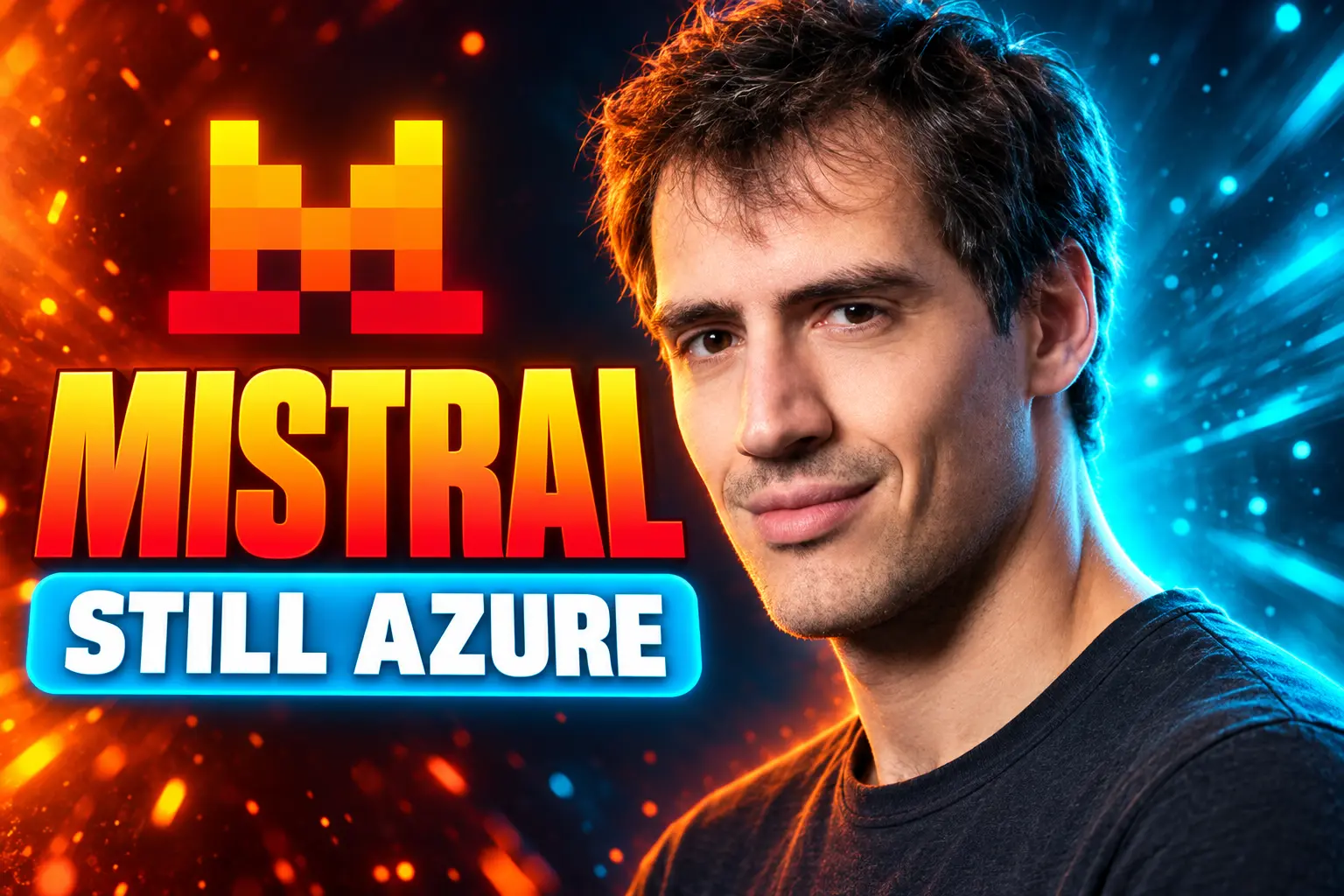
Mistral said the Series D is the largest European tech equity round ever completed, three years after the company launched in April 2023. Samsung Electronics led. Co-leads were the Scaleup Europe Fund, managed by EQT, and existing investor PSG Equity. New money came from Advent, funds and accounts managed by BlackRock, and the Grand Duchy of Luxembourg. ASML, NVIDIA, a16z, Bpifrance, BNP Paribas CIB, and Salesforce Ventures were among the existing backers who stayed in.
The company said it now operates in 20 countries and supports more than 125 enterprises, naming Airbus, ASML, and HSBC. Johan Bergqvist, the chief financial officer, said annual recurring revenue was slightly above $1 billion. Mistral said the new cash expands frontier research, scales training compute, and widens infrastructure and the commercial footprint.
MISTRAL’S EQUITY ROUNDS
| Round | Closed | Amount | Valuation | Lead |
|---|---|---|---|---|
| Series B | June 2024 | €600 million | about €6 billion | unlisted in the D note |
| Series C | September 9, 2025 | €1.7 billion | €11.7 billion | ASML |
| Series D | September 8, 2026 | €3 billion | more than €21 billion | Samsung Electronics |
Those three rounds add up to €5.3 billion. The mark went from €11.7 billion to more than €21 billion in twelve months, a rise of about 79 percent, which is just short of a double. The cap table is not a closed European club. Samsung is South Korean, BlackRock and a16z are American, and NVIDIA remains the chip supplier. The political story and the shareholder register are not the same list.
Mistral’s own post framed the round as a full-stack bet: open-weight models, the compute they run on, and the products that put them into production, so a customer is not stuck on one vendor’s roadmap or price. That is a different pitch from a chat app with a French accent, and it is the pitch Microsoft is now distributing.
https://x.com/MistralAI/status/2097188835897586083
The informed reading of that raise is that jurisdiction and control now clear a European record, even if Mistral still does not sit on top of every public model leaderboard. Capital is following a procurement thesis. The July offtake is how that thesis gets an Azure SKU.
What Azure Customers Can Run on Mistral Metal
Azure already sells Mistral as a catalog model, a Copilot Studio option, and a local runtime. Microsoft Foundry is the build plane. Foundry Local extends that plane onto Azure Local, so the same APIs can follow data into a bank hall or a disconnected site. Medium 3.5 is the open-weight model in that mix; OCR 4 is the document model.
Mistral Large 3, a sparse mixture-of-experts with 41 billion active parameters and 675 billion total, has been on Foundry since December 2, 2025, under an Apache 2.0 license. Microsoft listed the Global Standard SKU in West US 3 at $0.50 per million input tokens and $1.50 per million output tokens. The open weights can be exported, subject to Mistral’s license, into a VPC, an edge box, or a sovereign cloud. That is the escape hatch on paper. The default path for a team that already lives in Azure is to call the model where the rest of the estate already sits.
WHERE A MISTRAL MODEL CAN RUN FOR AN AZURE BUYER
- Microsoft Foundry: Medium 3.5, OCR 4, and Large 3 are catalog models for cloud apps and agents.
- Copilot Studio: Medium 3.5 is wired into Microsoft’s app-builder for staff-facing agents.
- Azure public cloud: The same names run next to the rest of an Azure estate, including the West US 3 global SKU for Large 3.
- Azure Local: Open models can run in a customer data center, including rooms with no external link.
- Mistral’s own regions: Studio and API traffic can be pinned to Europe or the United States on Mistral’s endpoints.
- Exported weights: Large 3 and other Apache models can be fine-tuned and hosted on metal the customer owns.
Microsoft’s sovereign cloud work is the other half of the shelf. The EU Data Boundary, completed on February 26, 2025, is a promise to store and process data in the EU and EFTA for core Microsoft cloud services, including most of Azure. A later EMEA update said Copilot processing for European customers can also stay inside that boundary, and that a European board of directors, in place from June 26, 2025, oversees datacenter operations under European law. Data Guardian limits remote access to Microsoft staff who live in Europe.
That package shrinks the legal gap Mistral sells against. It does not erase the CLOUD Act question that still hangs over any US parent. It does mean a large bank can now put “Mistral on Azure Local” and “Microsoft EU Data Boundary” on the same slide, which is a different sale from “leave American clouds.”
A Transfer Caveat Inside the Europe Endpoint
On August 11, 2026, Mistral said customers can choose Europe or US inference on Regional Endpoints, now generally available. Processing is supposed to happen in the selected region. The same post adds a limit: safeguarded transfers to sub-processors may still occur outside that region, as described in the company’s Trust Center. A Europe pin is a residency control, not a hard air gap.
A Priority Tier, in public preview, adds committed rate limits and an uptime SLA for production jobs. Mistral said it is the only European lab offering both a region choice and an SLA-backed tier. Models remain available through partners, which is how Azure, Amazon Bedrock, and others still sit on the same price list.
The August note also opens Mistral’s metal to third-party open weights, starting with Z.ai’s GLM-5.2. Future open models are meant to run under the same regional controls and service terms. That move turns Mistral Compute into a hosting layer, not only a house-model API. It also means “European sovereign inference” can serve a Chinese open-weight model on French-operated GPUs, which is consistent with a control pitch and awkward for a purity pitch.
Most Mistral customers, the company said, already run the models inside their own data centers and clouds. Regional Endpoints and the Priority Tier are for the slice that wants Mistral to operate capacity on their behalf. The rest are already on someone else’s cloud, and a large share of that someone is Microsoft.
The First Site Is 44 MW, Not 1 GW
The fundraising copy points at a gigawatt. The iron on the ground is a first cluster. In March 2026 Mistral said it had raised $830 million of debt from seven banks to buy 13,800 NVIDIA GB300 GPUs for a 44 MW site at Bruyères-le-Châtel in Essonne, south of Paris, in a hall owned and run by French operator Eclairion. The lenders were Bpifrance, BNP Paribas, Crédit Agricole CIB, HSBC, La Banque Postale, MUFG, and Natixis CIB. The stated aim was to start operations in mid-2026. Mistral also said it wants 200 MW of European capacity by the end of 2027, and up to 1 GW by 2030.
A separate €1.2 billion plan with EcoDataCenter in Borlänge, Sweden, is the first listed build outside France, aimed at 2027. European Compute Units, described in the August note, convert multi-year purchase commitments from an anchor group into access to that future metal. Named voices in that group include Amadeus, ASML, Capgemini, Caisse des Dépôts, and CMA CGM. Those orders sit on capacity that, by Mistral’s own map, is still being built.
MISTRAL COMPUTE ON THE MAP
| Site or target | Where | Scale | Status Mistral has stated |
|---|---|---|---|
| Bruyères-le-Châtel | France | 44 MW, 13,800 GB300 GPUs | Debt of $830 million closed March 30, 2026; mid-2026 start target |
| Borlänge with EcoDataCenter | Sweden | €1.2 billion investment | Announced 2026, opening aimed at 2027 |
| Near-term European target | Europe | 200 MW | By the end of 2027 |
| Long-term European target | Europe | up to 1 GW | By 2030 |
Forty-four megawatts is a real training cluster. It is not a hyperscale fleet. The gap from 44 MW to 1,000 MW is the project the Series D is supposed to fund, and it is also the project Microsoft is already counting as extra European capacity. If the offtake is large relative to the first hall, Azure demand will fill the racks before a French ministry does.
Unit cost follows that shape. A lab that buys GPUs on debt and leases halls starts at a different depreciation line from a hyperscaler that has amortized sites for a decade. The margin only works if the buyer pays extra for jurisdiction, an SLA, and a model they can inspect. That is a regulated-industry price, not a spot-GPU price.
France’s Armed Forces Already Signed a Framework
The French Ministry of the Armed Forces notified a framework award to Mistral on December 16, 2025, and published it on January 8, 2026. The Agence ministérielle pour l’intelligence artificielle de défense, AMIAD, runs the contract. It opens Mistral’s models, software, and services to the armed forces and to bodies under the ministry, including the Commissariat à l’énergie atomique, ONERA, and the naval hydrographic service. Bertrand Rondepierre, AMIAD’s director, presented it as a way to use current tools while keeping sovereign control of them.
That is the buyer Mistral’s pitch was written for. Public-sector and defense procurement in France already treats European incorporation and auditability as scoring items, through tools such as SecNumCloud. Germany’s BSI C5 plays a similar role. Financial firms under DORA, hospitals under national health-data rules, and ministries with residency mandates are the accounts where a French lab can beat a US parent on paper. They are not “European enterprise” as a whole. A carmaker that already runs SAP on Azure will not switch clouds for a model card.
Mensch has been blunt about the fear those accounts actually have. In a January 2026 interview recirculated as the round closed, he compared AI to a factory’s power grid and said enterprises will want to be sure nobody can switch them off.
If you assume that the entire economy is going to run on AI systems, enterprises will just want to make sure that nobody can turn off their systems.
Arthur Mensch, Co-founder and CEO, Mistral, January 2026 interview posted by a16z
Open weights are his answer to that fear, because a customer can keep the model when a vendor relationship sours. Azure Local and disconnected Foundry runtimes are Microsoft’s answer, because the same model can sit in a room with no cable out. Both answers can be true in one deployment. That is why the July pact is coherent for Microsoft and cramped for anyone who wanted Mistral to be a clean break.
Open Weights Land in Foundry and Copilot Studio
Every workload that starts in Foundry or Copilot Studio inherits Azure identity, billing, logging, and the procurement vehicle the customer already signed. Moving it later onto Mistral’s own Studio, or onto exported weights in an Eclairion hall, means rebuilding that glue. Plenty of banks will still do it for a system of record. Plenty of product teams will not. The open-weight license is the legal right to leave. The runtime is the habit that stays.
Mistral is now trying to be three firms at once: a frontier lab, a neocloud with a 1 GW slide, and a compliance layer inside Microsoft’s sovereign catalog. The Series D is large enough to fund the first two in Europe if the racks actually arrive. It is not large enough, on the public figures, to replace Azure as the place most of its existing customers already work. Microsoft, for its part, gets a French model line, extra GPU hours in the EU, and a reply to ministries that have been asking for a non-US name on the invoice.
The €3 billion round closed with that hybrid intact. Samsung and an EU-backed fund paid for more European metal. Microsoft had already said it would buy a slice of the output. The next test is whether the 44 MW hall, and the Swedish follow-on, fill with French and German regulated jobs, or with Azure demand that needed a European address.

Windows 11 26H2 Turns Settings Backup On by Default

The Gears 2 PC Port Epic Refused to Ship

Ghost Recon Wildlands Returns at 4K as a Catalog Product

Waterpark Simulator Keeps the $12.99 Price After 1.0

Nurix Puts NuPlay on Microsoft Marketplace to Reach Azure Buyers

Warzone Leaves Xbox One and PS4 After Season 06

Microsoft AI Was Set Free to Build Its Own Frontier

Microsoft IQ Turns Workplace Data Into a Metered Agent Brain

Xbox Games Showcase 2026 Split the Catalog in Two

Nadella Banned Addiction Talk While Scout Kept Heartbeat
-
 NEWS4 months ago
Warzone Leaves Xbox One and PS4 After Season 06
-
 NEWS4 months ago
Microsoft AI Was Set Free to Build Its Own Frontier
-
 MICROSOFT 3654 months ago
Microsoft IQ Turns Workplace Data Into a Metered Agent Brain
-
 NEWS4 months ago
Xbox Games Showcase 2026 Split the Catalog in Two
-
 MICROSOFT 3654 months ago
Nadella Banned Addiction Talk While Scout Kept Heartbeat
-

 NEWS4 months ago
Modern Warfare 4 Splits Its Audience Before the October Launch
-

 NEWS4 months ago
Infinity Ward Bets Modern Warfare 4 on a Paid DMZ
-

 NEWS4 months ago
Dragonwilds Hits Xbox, but Steam Saves Stay Put