
AZURE
Microsoft Turns the IDF Azure Review Into Global Rules
Microsoft’s June 2026 IMOD review ends as five worldwide security-customer checks, while Israel’s Defense Ministry stays on Azure, translation and cyber defense.

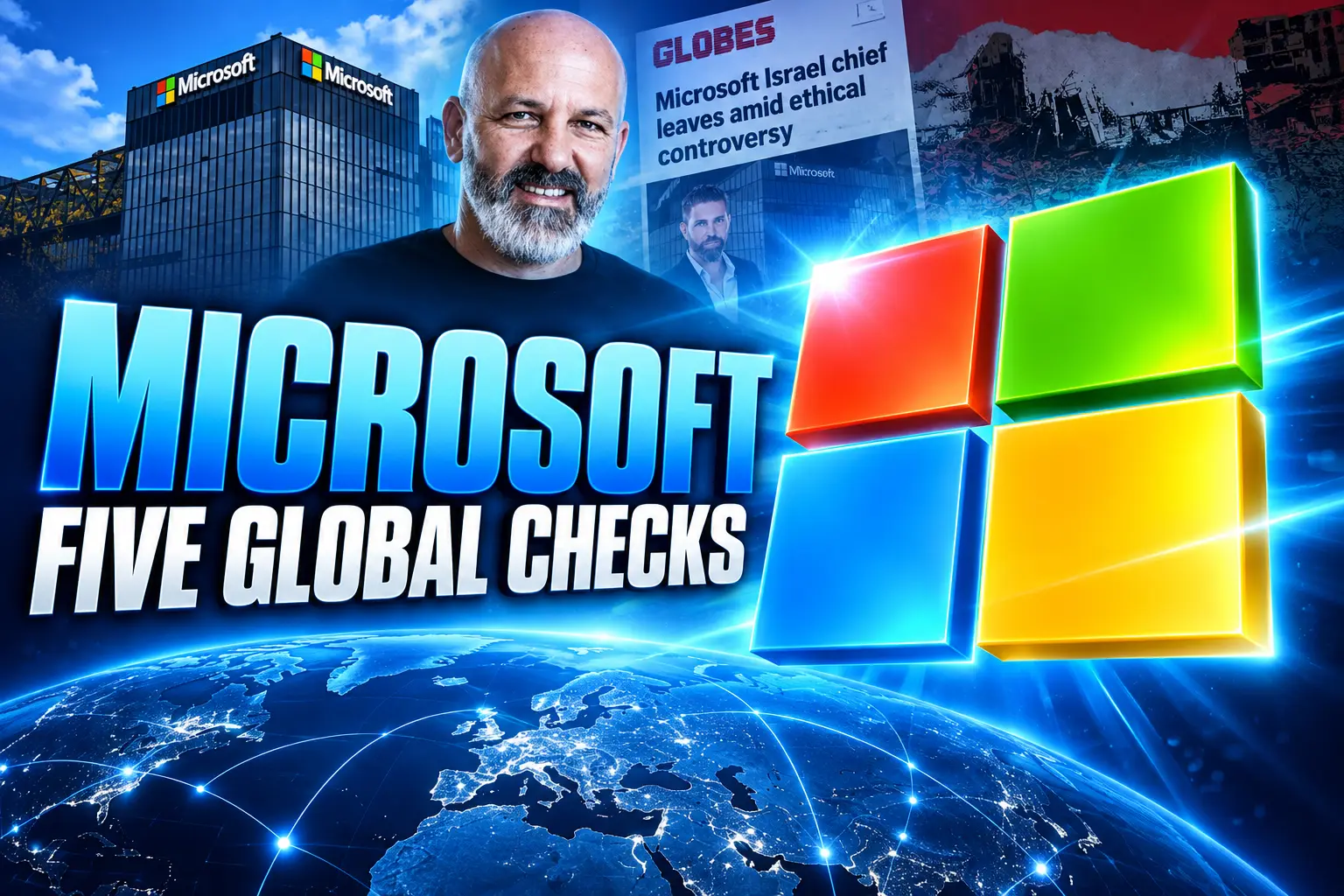
Microsoft on June 4, 2026 published a five-page close-out that turns the Unit 8200 Azure case into five checks for national-security customers in every market, not only Israel.
Specified cloud storage and AI accounts for the Israel Ministry of Defense stay off. Software, Azure, language tools, and cyber defense stay on, and the new rules travel with the next government deal.
Five Controls Now Apply to Every Security Customer
The company’s final update on the IMOD review is the product of an outside inquiry by Covington & Burling LLP, with a technical firm working under that firm’s direction. Microsoft says it never opened the ministry’s own files. The lawyers worked from Microsoft business records, including financial statements, internal documents, and mail.
Those records, Microsoft said on September 25, 2025, backed parts of August 6, 2025 reporting that a Defense Ministry unit used Azure to hold call recordings taken from Palestinian civilians in Gaza and the West Bank. The evidence Microsoft cited was IMOD’s use of Azure storage in the Netherlands and its use of AI services. Covington later finished the file; the company says the facts did not move.
The June paper then does something the September cut did not. It lists five workstreams written for national-security deals as a class, including clearance practice in non-U.S. markets and extra due diligence in conflict zones.
THE FIVE GOVERNANCE CHANGES
| Workstream | What Microsoft says it will do |
|---|---|
| Pre-contract review | Rework checks on national-security deals before they are signed, with a stronger human-rights pass |
| Security clearances | Review how it oversees clearances in some non-U.S. markets and train staff on those rules |
| Periodic use reviews | Revisit acceptable-use and national-security rules when politics or a project’s scope changes, including in high-risk conflict areas |
| Staff guidance | Give employees clearer teaching on how use rules work in practice and when to escalate |
| New reporting path | Let staff flag worries about how technology is built or deployed, including with no name attached |
Microsoft still bars uses that facilitate mass surveillance of civilian populations, and it still requires human oversight and access controls under its Acceptable Use Policy and Enterprise AI Services Code of Conduct. The June text presents those bars as global. The new machinery is how Redmond says it will police them after a customer in a war zone blew through them.
What Microsoft Still Sells the Defense Ministry
Microsoft still sells Israel’s Defense Ministry software, professional services, Azure, Azure AI including language translation, and help protecting Israeli cyberspace, the June update says, describing the account as a standard commercial relationship. That is the live stack after the September 2025 cut, which hit specified storage and AI subscriptions tied to the unit in the reporting, not the whole ministry.
WHAT REMAINS ON THE ACCOUNT
- Software and services: Desktop licensing and professional services stay in the commercial relationship Microsoft describes with the ministry.
- Azure and Azure AI: Cloud and AI services remain, with language translation named in the June update as part of what IMOD still buys.
- Cyber defense: Brad Smith told staff the September cut does not touch work protecting the cybersecurity of Israel and other countries in the Middle East, including under the Abraham Accords.
- Translation-heavy use: A May 2026 joint letter to Satya Nadella and Brad Smith, citing leaked contract files, put translation and a large language model at almost 75 percent of the ministry’s Microsoft usage, with speech and voice covering the rest.
- A separate 2024 licence line: Israel’s 2024 budget-execution report lists a software-licensing deal with Microsoft worth 464 million shekels, about $125 million, expected to run to 2027; Microsoft said it had nothing to add.
Between October 2023 and June 2024 the ministry also bought about 19,000 hours of Microsoft engineering support, worth about $10 million, according to the same joint letter. Israel’s Nimbus government cloud contract went to Amazon and Google, so this remaining Microsoft work sits outside that tender. A July 2026 investor filing with the SEC said Microsoft still maintains extensive contracts with the ministry and that the June paper addressed one specific case of misuse by a single unit.
The Israel Office Lost Its General Manager
The account in Herzliya took the personnel hit. Alon Haimovich, Microsoft Israel’s general manager for four years, stepped down on May 31, 2026. He joined in 2019 as public-sector lead. Microsoft’s own note said he would start a new path in technology and artificial intelligence, and that a successor would come later.
People familiar with the internal work said global management looked at whether the Israel office had been fully open about how the Defense Ministry used the systems, and at staff who had served, or still serve as reservists, in Unit 8200. Several managers in the local governance group also left. Until a new country head arrived, the Israel office reported through Microsoft France, a shift that followed the fact that the storage Microsoft cited sat on European soil.
On August 17, 2026 Microsoft named Nati Amsterdam, a longtime Nvidia Israel country director and former VMware Israel chief, as the next general manager. He starts in October. Avi Yoshi, who ran the subsidiary on an interim basis, stays as chief technology officer.
THE IMOD AZURE FILE
- May 15, 2025: Microsoft says an internal review plus outside fact-finding has found no evidence to date that Azure or AI technologies were used to target or harm people in Gaza.
- August 6, 2025: New reporting alleges Unit 8200 stored civilian Palestinian call files on Azure; Microsoft opens a second, lawyer-led review.
- September 25, 2025: Microsoft disables specified IMOD cloud-storage and AI subscriptions after finding evidence on Netherlands storage use and AI services.
- December 5, 2025: Shareholders reject a proposal asking the board to publish a report on whether human-rights due diligence actually works.
- May 31, 2026: Haimovich leaves; the Israel office reports through Microsoft France while several local governance managers also exit.
- June 4, 2026: Microsoft issues the five-area final update and says Covington’s facts are unchanged.
- August 17, 2026: Amsterdam is named to run Microsoft Israel from October.
The office that now reports through France is the same office that built the local relationship. The June paper never names the departures. It exports process instead.
A New Portal After the Sit-Ins
Employee pressure ran in parallel with the lawyers. No Azure for Apartheid, a staff and ex-staff group, interrupted company events, camped at Redmond, and in late August 2025 entered the office of Brad Smith, vice chair and president. Microsoft had the group removed by police. It later fired workers it said had broken conduct rules, including people involved in the sit-in. In June 2026, around the week the final update landed, activists were again outside a Microsoft developers conference in San Francisco demanding a full cut.
The company’s answer inside the walls is a new lane on the Microsoft Integrity Portal labeled Trusted Technology Review. Any employee who thinks a build or a deployment may break company policy on how technology is developed or used can file there, with no name attached if they want. The Trusted Technology group follows up and, when it fits, sends the file to the right team. Standard confidentiality and non-retaliation rules apply, Microsoft says.
We do not provide technology to facilitate mass surveillance of civilians. We have applied this principle in every country around the world, and we have insisted on it repeatedly for more than two decades.
Brad Smith, Vice Chair and President, note to employees
Smith also told staff that Microsoft had ceased and disabled a set of services to a unit inside the Defense Ministry, and that the company is not a government. The louder objection after that note, including in the months around the June close-out, is that a unit-level storage and AI cut leaves translation, other Azure work, and software licensing in place, so the portal and the five checks have to do a job the September disable did not.
Shareholders Already Voted No on a Harder Report
Investors had already asked for a tougher public test. At the December 5, 2025 annual meeting, a shareholder proposal sought a board report on whether Microsoft’s human-rights due diligence actually stops customers from using Azure and AI in ways that violate human rights or the laws of war. The board told shareholders to vote against it, pointing to existing UN Guiding Principles work, OECD-aligned processes, and a Human Rights Transparency Report.
DECEMBER 5, 2025 RIGHTS VOTES
| Proposal | Result | Votes for | Share of for-plus-against |
|---|---|---|---|
| Report on human rights due diligence | Not approved | 1,336,945,255 | 26.34% |
| Report on data operations in human rights hotspots | Not approved | 1,406,735,187 | 27.48% |
A 26 percent vote is not a win, and it is not noise either. Six months later Microsoft published its own five-page IMOD summary rather than the effectiveness study the filers wanted. That is the sequence: shareholders failed to force a broad report, the company then used one customer’s breach to rewrite how it will screen the next one.
Clearance Rules Outside the United States
The line in the June paper that will land on other capitals is the clearance workstream. Microsoft says it already follows local clearance law everywhere it works. It also says it will look harder at how it manages clearances in certain countries and will change practice so employees know how those requirements sit inside a Microsoft job. That is a direct answer to a dual-hat problem the Israel file made visible: staff who sell and run a project for a unit they also serve in uniform.
Periodic reviews are the other export. Microsoft says it will watch for new political facts and for changes in the scope of sensitive projects, and that it has found room to strengthen due diligence in conflict-affected and high-risk areas. Pre-contract review for national-security deals is already being rebuilt, the company says, so the human-rights pass happens before a signature, not after a newspaper story.
Other cloud and AI vendors still face the same public fight over Israel contracts. Microsoft is the one that cut a named unit, moved a country office’s reporting line, stood up an anonymous technology-review channel, and then wrote the lesson as five global workstreams. Amsterdam walks into that in October: a France-facing Israel office, a smaller IMOD stack, and a rulebook that now sits on every security-agency Azure deal Redmond signs.
Frequently Asked Questions
What Did Microsoft Disable for the Defense Ministry in September 2025?
Specified IMOD subscriptions for particular cloud storage and AI services, after Microsoft found evidence on Netherlands Azure storage use and AI services. The company reviewed that cut with the ministry and gave IMOD a chance to show the disabled services still fit Microsoft’s terms; public reporting at the time said the ministry planned to move the data at issue onto a competing cloud.
How Does Microsoft’s Trusted Technology Review Work?
It is a new section of the Microsoft Integrity Portal where any employee can raise a concern about how the company develops or deploys technology, including with no name attached. The Trusted Technology group that runs the portal follows up and, where it fits, routes the file to the right team, and Microsoft says the channel will be covered in company-wide training in FY27.
How Did Shareholders Vote on Microsoft Human Rights Reports in 2025?
Both rights proposals failed on December 5, 2025. The due-diligence report drew 26.34 percent support, while a companion proposal on data operations in human rights hotspots drew 27.48 percent, and Satya Nadella was re-elected the same day with 93.46 percent of votes cast.
Did Microsoft Give Israel Extra Help After October 7, 2023?
Yes, on a short, limited basis. A footnote in the June 2026 update says Microsoft sometimes grants special access beyond standard commercial terms, and that after October 7 it gave the Israeli government limited emergency support to help rescue hostages, approving some requests and denying others, with oversight meant to protect civilian privacy in Gaza as well.

The Gears 2 PC Port Epic Refused to Ship

Ghost Recon Wildlands Returns at 4K as a Catalog Product

Waterpark Simulator Keeps the $12.99 Price After 1.0

Nurix Puts NuPlay on Microsoft Marketplace to Reach Azure Buyers

Xbox Studio Leaders Detest Game Pass for Devaluing $40 Games

Warzone Leaves Xbox One and PS4 After Season 06

Microsoft AI Was Set Free to Build Its Own Frontier

Microsoft IQ Turns Workplace Data Into a Metered Agent Brain

Xbox Games Showcase 2026 Split the Catalog in Two

Nadella Banned Addiction Talk While Scout Kept Heartbeat
-
 NEWS4 months ago
Warzone Leaves Xbox One and PS4 After Season 06
-
 NEWS3 months ago
Microsoft AI Was Set Free to Build Its Own Frontier
-
 MICROSOFT 3653 months ago
Microsoft IQ Turns Workplace Data Into a Metered Agent Brain
-
 NEWS3 months ago
Xbox Games Showcase 2026 Split the Catalog in Two
-
 MICROSOFT 3653 months ago
Nadella Banned Addiction Talk While Scout Kept Heartbeat
-

 NEWS4 months ago
Modern Warfare 4 Splits Its Audience Before the October Launch
-

 NEWS3 months ago
Infinity Ward Bets Modern Warfare 4 on a Paid DMZ
-

 NEWS3 months ago
Dragonwilds Hits Xbox, but Steam Saves Stay Put